
Most eSIM content is written for people who want to sell data plans to travellers. This one is written for a different reader: an IT service provider, consultancy or telecom reseller whose clients are companies, and who is deciding whether managed connectivity belongs in their portfolio.
The commercial logic is straightforward. The expensive part of a connectivity business is acquiring the customer. If you already hold the relationship with an IT manager or a procurement lead, you have solved that problem before you start. What remains is deciding what to deliver, how to price it, and what you need in place before you take the first client live.
What this covers
- An eSIM managed service is not reselling data. It is selling the administration, control and reporting around connectivity.
- IT service providers already hold the buyer relationship, which is the expensive part of this business.
- Corporate accounts churn far less and negotiate far less aggressively than consumers.
- Recurring management fees usually matter more to your margin than the data markup.
- The main constraint is not technology. It is device eligibility and internal policy at the client.
What an eSIM managed service actually delivers
The distinction that matters is between supplying connectivity and managing it. Anyone can resell data. A managed service is defined by the layers that sit around the data, and those layers are what the client is actually paying for.
| Service layer | What you actually do | How it is usually charged |
|---|---|---|
| Connectivity supply | Source wholesale data and package it into plans that match how the client travels | Markup on the data, or pass-through with a fee |
| Provisioning and lifecycle | Issue, install, reassign and retire profiles as staff and devices change | Per device or per user, monthly |
| Policy and controls | Set data caps, restrict destinations, approve overages, prevent bill shock | Included in the management fee |
| Reporting and cost allocation | Usage by user, team, cost centre or trip, in a form finance will accept | Included, or priced as a premium tier |
| Support | Handle the traveller who cannot connect, in their time zone | Bundled, or by SLA tier |
| Procurement and review | Quarterly review of spend, coverage and plan fit | Retainer or included in annual contract |
Not every provider offers every layer. The ones further down the table are what separate a managed service from a reseller relationship.
Read that table from the bottom up if you want to understand the pricing power in this business. The connectivity supply at the top is close to a commodity, and margins there compress over time. The reporting, policy and review layers at the bottom are where clients feel the value and where they are least inclined to switch provider over a small price difference.
Why IT service providers are well placed for this
The eSIM market has grown to the point where corporate deployment is practical rather than experimental. GSMA Intelligence counted 395 eSIM-capable device models announced as of mid-2025, up from 333 in 2024 and 231 in 2023, which means the hardware constraint that made corporate rollouts awkward has largely cleared.
Sources: GSMA Mobile Economy Report 2026; GSMA Intelligence device tracker.
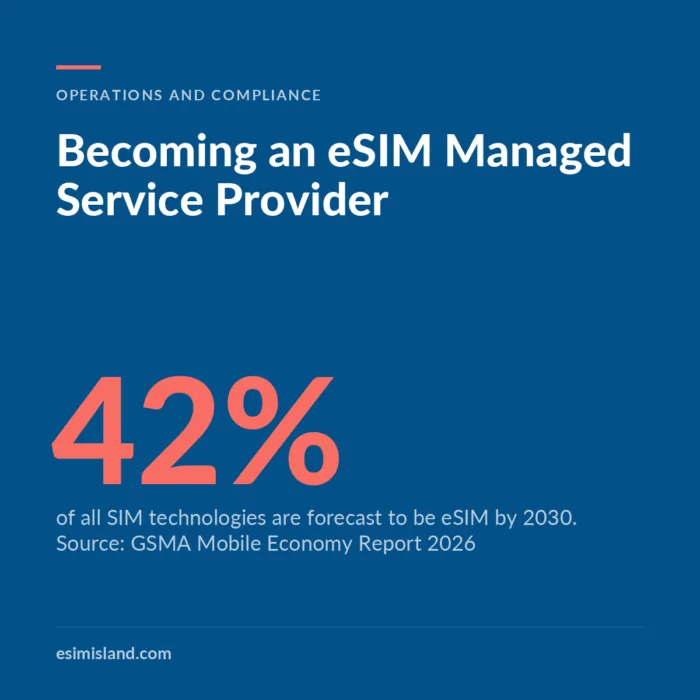
The GSMA Mobile Economy Report 2026 forecasts eSIM reaching around 42% of all SIM technologies by 2030, with 2.5 billion eSIM smartphone connections by 2028. For an MSP, the useful reading of those numbers is not that a huge market is arriving, but that client device estates are becoming eSIM-capable by default through normal refresh cycles. The question shifts from whether to adopt to who will administer it.
That is the opening. Most IT teams do not want to manage international connectivity themselves. It is fiddly, it generates support tickets at inconvenient hours, and it produces expense claims nobody enjoys reconciling. It is exactly the kind of work that gets outsourced to a provider who already handles adjacent systems.
The cost argument, and why it is not the main one
Every managed connectivity proposal includes a cost comparison, so it is worth knowing the current numbers. Kaleido Intelligence found average travel eSIM spend per trip at around $28 in 2026, up 133% year on year, against roughly $42 on operator roaming, down 9%.
Average traveller spend per trip, 2026
Source: Kaleido Intelligence traveller survey, 2026. The gap is the headline saving in most managed connectivity proposals, though the operational case is usually stronger than the price case.
Two things are worth noticing. The saving is real but narrower than it was, because eSIM buyers are trading up to larger allowances rather than buying the cheapest option. And roaming spend is falling, which means the comparison will keep tightening as operators respond.
How to price a managed eSIM service
The most common pricing mistake is to charge only a markup on data. It ties your revenue to how much the client travels, which is outside your control, and it leaves all the administration, reporting and support work unpaid.
| Model | How it works | Best when | Watch out for |
|---|---|---|---|
| Data markup only | You buy wholesale and resell with a margin | Small accounts, simple needs | Revenue falls when the client travels less; no reward for the admin work |
| Per-user monthly fee | Fixed fee per managed user or device, data charged separately | Predictable headcount, frequent travellers | Clients query the fee in months with little travel |
| Bundled allowance | Fixed monthly price including an agreed data pool | Clients who value budget certainty above all | You carry the overage risk; model it before quoting |
| Tiered service levels | Basic, managed and fully managed, priced by support and reporting depth | Mixed client base with different needs | Tiers must differ in substance, not just in price |
| Project or rollout fee | One-off charge for audit, migration and deployment | Large initial deployments | Underquoting the device audit, which always takes longer than expected |
The models that work best in practice separate the recurring management fee from the data. The fee covers provisioning, policy, reporting and support, and it continues in quiet months. The data is either passed through at a transparent margin or bundled into an allowance you have modelled carefully. That structure survives a client asking why they paid you in a month when nobody travelled, which is a conversation that arrives eventually.
How the economics compare to consumer reselling
If you are weighing managed services against a consumer travel eSIM store, the differences are structural rather than marginal.
| Consumer travel eSIM | Managed eSIM service | |
|---|---|---|
| Order value | Around $28 per trip | Recurring, per user, across a contract |
| Acquisition | Paid or content, cost rising | Existing client relationship |
| Churn | High; many buy once | Low; contracts renew |
| Price sensitivity | Very high | Moderate; reliability outranks price |
| Sales cycle | Minutes | Weeks to months |
| Support load | Concentrated at first install | Ongoing but predictable |
| What you are really selling | A data plan | Control, visibility and one fewer thing for IT to manage |
The line that matters most is churn. A consumer travel eSIM business spends heavily to acquire customers, many of whom buy once. A managed service client who is properly served renews, and the cost of keeping them is a fraction of the cost of finding them. That is why several resellers who start on the consumer side find the corporate half of the business becomes the more profitable one within a year.
What to put in place before your first client
The technology is the easy part. The work that determines whether the first deployment goes well is mostly done before anything is provisioned.
Audit device eligibility before you promise anything
Establish how much of the client fleet actually supports eSIM and whether any handsets are carrier-locked. This is the single most common cause of a stalled rollout, and it is far cheaper to discover during scoping than during deployment. Expect a mixed estate and plan a phased migration rather than a switch-over.
Choose a provider on dashboard and API, not on rate alone
For a managed service, the administration layer is the product. You need bulk provisioning, real-time usage data, profile diagnostics, the ability to reassign or reissue a profile, and webhooks you can feed into your own tooling. A provider with excellent rates and a weak dashboard will cost you more in manual work than the rate saves.
Design plans around travel patterns, not around the rate card
Look at where the client actually travels and how often, then build packages that match. A sales team crossing several borders on one trip needs multi-country plans. A field team returning to the same two countries needs something quite different. Generic regional bundles leave margin on the table for both of you.
Write the policy layer into the contract
Agree caps, approval thresholds for overage, which destinations are enabled and who can authorise changes. This is what prevents the bill-shock conversation that ends managed service relationships, and it is also a large part of what the client is paying you for.
Pilot with one team before rolling out
Run twenty to fifty users for a full travel cycle. You are testing activation success, support volume, reporting fit and whether your pricing model survives contact with real usage. Fix what breaks here, not at three hundred users.
Set the review rhythm from day one
Quarterly reviews of spend, coverage and plan fit turn a supply arrangement into a managed service and give you a natural opportunity to expand the account. Clients who never hear from you between invoices are the ones who go back to market.
Step one is the one most frequently skipped and most frequently regretted. A client fleet is almost never uniformly eSIM-capable, and discovering that after you have quoted a fixed rollout fee is an expensive lesson. Audit first, quote second, and phase the migration around the device refresh cycle rather than against it.
What goes wrong, and what clients ask
The failure modes in managed connectivity are consistent enough to list, and so are the questions buyers ask in the first meeting.
What goes wrong
- Quoting before auditing device eligibility
- Pricing on data markup alone, so admin work is unpaid
- Support that runs one time zone while staff travel across all of them
- Reporting that finance cannot map to cost centres
- No agreed overage policy, leading to a bill-shock dispute
- Choosing a provider who will not let you reissue a profile without escalation
What clients actually ask
- Which carriers will our staff be on in our top destinations?
- What happens when someone lands and cannot connect?
- Can we cap spend per user or per trip?
- Can we see usage by team and by cost centre?
- How fast can we add or remove a user?
- What happens to our data and profiles if we leave you?
The last item in each column is the same issue viewed from both sides. Clients ask what happens to their data and profiles if they leave, and you should be asking your wholesale provider the same question. If switching provider means losing your client’s configuration and history, you have built your service on someone else’s terms.
Frequently asked questions
Add managed connectivity to your service portfolio
eSIM Island supplies the wholesale rates, Connect+ dashboard and API that let IT service providers deliver eSIM as a managed service. Tell us about your client base and the markets they travel to and we will prepare pricing you can build a proposal on.
Book a Free DemoOr explore the Reseller Program, API Integration and Business Roaming.
Leave a Reply