
Cruise connectivity is usually discussed as an onboard satellite problem, and that is a real and expensive one. It is also not the problem this article is about.
The gap most cruise lines are not filling is the port day: a passenger stepping ashore in a foreign country for eight hours with no data, unable to navigate, use ride-hailing, pay with a phone, or contact the ship. That is a terrestrial connectivity problem with a straightforward solution, and it is worth being precise about the boundary between the two.
Be clear about what this does and does not solve
- A travel eSIM uses terrestrial mobile networks. It does not work at sea, out of range of shore.
- It solves the port day, which is where passengers actually spend money and get lost.
- Onboard connectivity remains a satellite product and a separate purchase.
- Cruise itineraries are multi-country by definition, which is exactly where regional plans earn their premium.
- Crew on shore leave are a distinct and often larger opportunity than passengers.
Where a travel eSIM works and where it does not
This distinction matters more in cruise than in any other travel vertical, because the potential for a passenger to misunderstand what they have bought is unusually high.
| Situation | Does a travel eSIM work? | What actually applies |
|---|---|---|
| Alongside in port | Yes | Normal terrestrial coverage from the local network |
| Ashore on an excursion | Yes | The core use case; navigation, messaging, payments |
| Close inshore, coastal transit | Sometimes | Depends on distance from shore and local coverage; unreliable |
| Open sea | No | Onboard satellite connectivity only |
| Fly-cruise travel days | Yes | Airport transfers, hotel nights either side of the sailing |
| Crew on shore leave | Yes | Often the strongest case; frequent, repeat, price-sensitive |
Coverage close inshore varies considerably by region and by network. Do not build a passenger promise around it.
Coverage close inshore is the row that causes trouble. Depending on distance from land and the local network, a phone may hold a signal for some distance offshore. It is not reliable, it varies enormously by region, and it should never form part of a passenger promise. Sell the port day and let anything beyond it be a pleasant surprise.
Why cruise passengers convert well
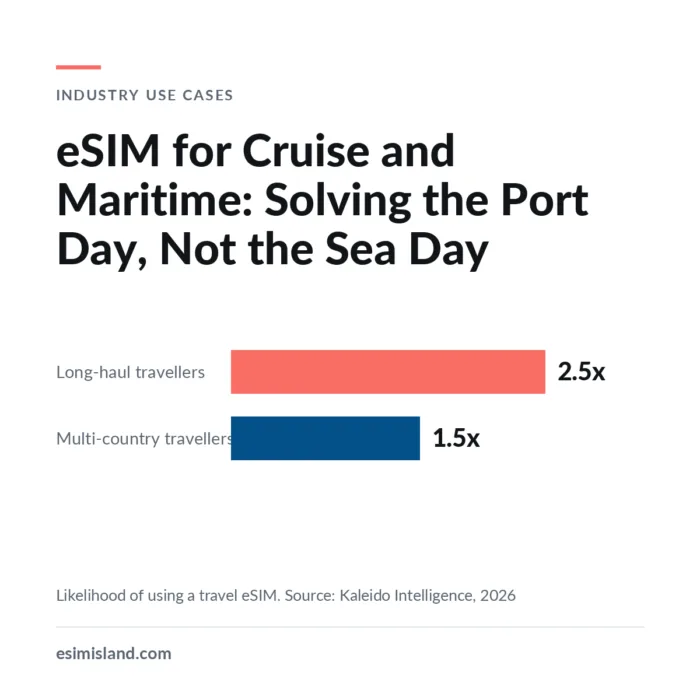
Who is most likely to use a travel eSIM
Source: Kaleido Intelligence, 2026. A cruise itinerary is long-haul and multi-country by definition, which puts passengers in both groups at once.
Sources: Kaleido Intelligence, 2026; Opensignal, Q2 2026.
The commercial point is that a cruise itinerary is a multi-country product by nature. A passenger trying to solve this themselves would need to understand which countries they are calling at, buy separate plans or accept roaming charges in each, and install profiles between ports. A single regional plan covering the whole itinerary is genuinely better than what they could arrange alone, which is a rare position in travel connectivity.
Six commercial models
| Model | How it works | Commercial effect |
|---|---|---|
| Pre-cruise upsell | Offered in booking confirmation or pre-departure documents | Direct margin, and the only point where installation is easy |
| Bundled with shore excursions | Included when a passenger books excursions | Raises excursion attach and reduces lost passengers |
| Regional itinerary plan | One multi-country plan covering every port on the itinerary | Best margin; hard for a passenger to assemble themselves |
| Included in premium fares | A cabin grade or fare family benefit | Differentiation rather than direct revenue |
| Crew welfare programme | Discounted plans for crew on shore leave | Recruitment and retention value; steady repeat volume |
| Group and charter | Bulk profiles for a chartered sailing or incentive group | Single decision, large order |
The crew row deserves separate attention. Crew go ashore repeatedly over a contract of several months, spend their own money on connectivity to contact family, and are highly price-sensitive. A discounted crew connectivity programme is a welfare benefit with real recruitment and retention value in a sector where both are difficult, and it generates steady repeat volume rather than one-off sales.
The excursion bundle is the other underused option. A passenger booking a shore excursion has told you exactly when and where they will be ashore, which makes a connectivity offer relevant and well-timed, and a connected passenger is considerably less likely to become an operational problem at the all-aboard time.
Getting the operations right
What makes it work
- Regional plans matched to the itinerary, not one country
- Sold and installed before boarding, while passengers are on shore
- Validity covering the whole sailing plus travel days
- Clear statement that it works in port, not at sea
- Device compatibility checked at the point of sale
- A named contact for passengers who cannot connect
What causes complaints
- Any implication that it works at sea
- Selling onboard, where installation may be impossible
- Single-country plans on a multi-country itinerary
- Validity ending before the final port
- Confusion with the ship's satellite wifi package
- No support once the ship has sailed
The timing constraint is stricter here than anywhere else in travel. In most verticals a late offer merely converts poorly. On a ship, a passenger who has sailed may be physically unable to download a profile without first buying satellite wifi, which turns a connectivity product into a paradox. Everything has to happen before boarding.
How to launch it
Map the itinerary to a coverage plan
List every country a passenger can set foot in, including transit ports and fly-cruise origins. That list, not the region name, is what your plan needs to cover. A Mediterranean sailing can touch four or five separate countries with very different wholesale rates.
Sell it before boarding
Once a passenger is aboard and at sea, installing a profile becomes difficult or impossible without paying for satellite wifi first. Pre-departure documentation is the practical selling and installation window.
Write the coverage promise carefully
State plainly that the plan works ashore and in port and that onboard connectivity is separate. Passengers who believe they have bought internet for the whole voyage will be disappointed at sea and will say so in reviews.
Treat crew as a separate programme
Crew go ashore repeatedly across a contract, spend their own money, and are highly price-sensitive. A discounted crew plan is a welfare benefit with genuine recruitment and retention value, and it produces steady repeat volume.
Bundle with excursions where you can
A passenger booking a shore excursion is telling you exactly when and where they will be ashore. Connectivity attached to that booking is relevant, well-timed and reduces the operational problem of passengers going missing.
Plan support around port days
Demand is concentrated on the mornings passengers first go ashore. Brief whoever handles guest services for that window, with the ability to reissue a profile.
Step one is where most of the value is created or lost. Regional labels are not coverage. A Baltic or Adriatic itinerary can call at several countries with quite different wholesale rates and network quality, and a plan built on the region name rather than the actual port list will have gaps that passengers discover at the worst moment.
Frequently asked questions
Cover the whole itinerary, not one country
eSIM Island supplies cruise lines and charter operators with regional multi-country plans built around your actual port lists, plus bulk provisioning for crew programmes. Tell us your itineraries and passenger volumes and we will prepare a proposal.
Book a Free DemoOr explore the Reseller Program, API Integration and Business Roaming.
Leave a Reply