
Connectivity is one of the few travel costs that does not sit cleanly with anybody. It arrives partly on a telecom invoice that IT reviews and partly as expense claims that finance processes, and the traveller experience it produces is owned by nobody until something goes wrong.
This is the travel manager’s view of the problem: why it lands on your desk despite the devices not being yours, what the cost actually is once you add up where it hides, the policy questions that are genuinely yours to answer, and how to get a rollout approved.
Why this lands on the travel manager's desk
- Connectivity is a travel cost that behaves like a telecom cost, so it falls between two owners.
- It affects traveller experience and duty of care, which are yours regardless of who pays the bill.
- Most of the spend arrives as unreconciled expense claims rather than a managed line.
- The policy questions, caps, approvals and enabled destinations, are travel policy questions.
- If you own travel policy, you can fix this whether or not you own the devices.
Why nobody owns this
Every organisation with international travel has the same set of unassigned questions.
| Question | Usually owned by | Why it stalls |
|---|---|---|
| Which devices can take an eSIM | IT | Travel has no visibility of the estate |
| What a traveller is allowed to spend on data | Travel policy | Often unwritten, so nobody enforces it |
| Who approves an overage abroad | Finance or line manager | No defined route, so it happens after the fact |
| Whether a traveller is reachable | Travel, under duty of care | Assumed rather than verified |
| Where the cost lands | Finance | Split between telecom invoices and expense claims |
| Who fixes it when it fails abroad | Nobody, in practice | The traveller solves it themselves and expenses it |
The pattern most organisations recognise: no single owner, so the default is that the traveller improvises and finance pays afterwards.
The last row is the honest one. In most organisations, a traveller who lands without data buys a local SIM, an airport wifi pass or an operator day bundle, uses it, and expenses it. That is a functioning process in the sense that people stay connected, and a poor one in every other sense: unbudgeted, unreconciled, unmonitored and invisible until the expense report arrives.
What it actually costs
The headline comparison is the easy part.
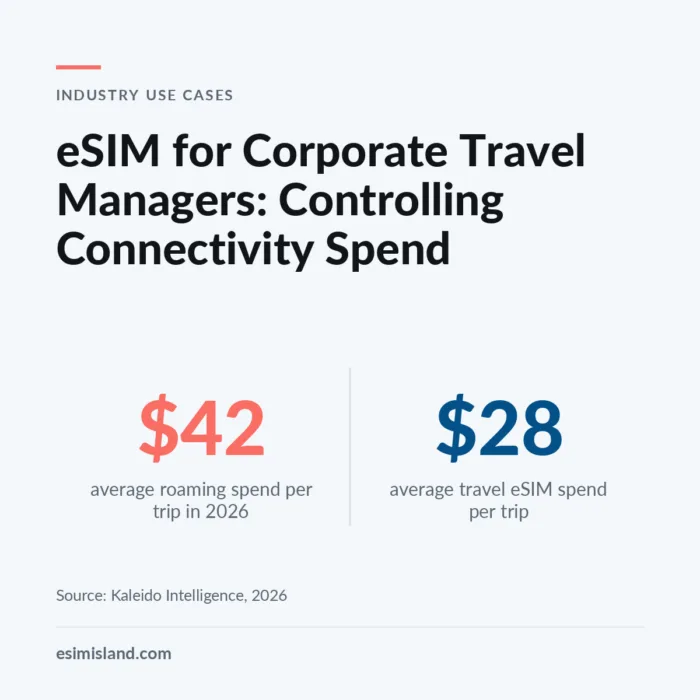
Average traveller spend per trip, 2026
Source: Kaleido Intelligence traveller survey, 2026. Consumer benchmarks; your own per-trip cost from twelve months of expense and telecom data is the figure that matters.
Sources: Kaleido Intelligence, 2026; GSMA Intelligence; GSMA Mobile Economy Report 2026.
Kaleido Intelligence put average spend per trip at around $42 on operator roaming against roughly $28 on travel eSIM in 2026. Useful for orientation, and not the number that will persuade anyone internally, because against a long-haul flight and four hotel nights a $14 difference is noise.
The real figure is what you get when you add the places connectivity spend hides.
| Cost | Where it hides | What managed connectivity does |
|---|---|---|
| Roaming charges | The telecom invoice, months later | Capped before the spend happens |
| Local SIMs bought on arrival | Expense claims, miscoded | Removed entirely |
| Airport wifi and day passes | Small expense lines nobody reviews | Removed entirely |
| Lost productive time on arrival | Nowhere; it is never counted | Traveller connected on landing |
| Expense processing | Finance headcount | One line instead of scattered claims |
| Duty of care exposure | Risk register, if at all | A traveller who can be reached and can call for help |
The two rows without a number attached are the ones that usually move the decision. Lost productive time on arrival is never counted anywhere, and it is the most consistently reported traveller complaint about international trips. And duty of care is a governance question: if your policy assumes travellers are reachable, it is worth knowing whether they actually are during the first hours in a country.
The policy questions that are yours
You may not own the device estate, but you own travel policy, and that is where most of the decisions actually sit.
What travel policy should state
- The data allowance per trip or per traveller
- Which destinations are enabled by default
- Who approves an increase, and how fast
- That local SIMs and day passes are no longer reimbursable
- What a traveller does if connectivity fails abroad
- Whether personal devices are in scope
What travellers need to know
- Their number does not change
- To install before departure, not on arrival
- How to set the eSIM as the data line
- To enable roaming on the new profile
- When validity starts
- One channel that works on airport or hotel wifi
The item that changes behaviour fastest is on the left: making local SIMs and day passes non-reimbursable. Until that changes, a proportion of travellers will keep doing what they have always done, and you will be running two systems while paying for both.
Getting it approved and rolled out
Pull the real number first
Twelve months of roaming charges from the telecom invoice, plus every expense line for local SIMs, day passes and airport wifi. Most travel managers have never seen these two figures added together, and the combined total is usually the argument that gets the project approved.
Get IT to run a device eligibility check
You need to know what proportion of travelling staff carry eSIM-capable, unlocked handsets. This determines whether you are looking at a full rollout or a phased one, and it is the fastest way to make the conversation concrete with IT.
Write the policy before choosing a supplier
Allowance, enabled destinations, approval route and what is no longer reimbursable. This is your territory and it does not depend on which platform you pick. Having it written makes supplier evaluation far quicker.
Pilot on your highest-travel team
Twenty to fifty travellers across a full travel cycle. Measure activation success, how many support requests arise, and whether the usage reporting fits how you already report travel spend.
Close the expense loophole at go-live
If local SIMs remain reimbursable, a proportion of travellers will keep buying them and you will run two systems. Update the expense policy on the same day the first wave goes live.
Report against the baseline at ninety days
Compare actual connectivity spend against the number from step one, and include the expense claims that disappeared. That comparison is what secures the next wave.
Step one is the whole business case. Very few organisations have ever added the roaming line from the telecom invoice to the scattered expense claims for local SIMs and wifi passes. When those two numbers are combined, the total is usually larger than anyone expected, and the approval conversation becomes straightforward.
Step two is where travel and IT have to meet. You need eligibility data you cannot generate yourself, and IT needs a business reason to prioritise it. Bringing the combined spend figure to that conversation is considerably more effective than asking for a device audit in the abstract.
Frequently asked questions
Bring connectivity into your travel programme
eSIM Island supplies business roaming with per-traveller caps, real-time usage and reporting that maps to your cost centres. Send us your traveller headcount, destination mix and current roaming spend and we will prepare a proposal.
Book a Free DemoOr explore the Reseller Program, API Integration and Business Roaming.
Leave a Reply