
Managing mobile connectivity across a workforce that travels has always been an awkward job. It involves physical objects that get lost, invoices that arrive after the spending has happened, and employees who land in another country and discover they have no data. None of that is difficult in principle. It is simply persistent, manual and hard to control.
eSIM changes the mechanics rather than the requirement. Profiles are assigned rather than shipped, spend is capped rather than discovered, and usage is attributable before the invoice arrives. This is a practical guide to what that looks like in operation, what a management platform actually needs to do, and where enterprise rollouts go wrong.
What changes for a mobility team
- Provisioning stops being a logistics problem and becomes an administrative one.
- Connectivity can be assigned, capped, reassigned and retired without anyone touching a device.
- Spend becomes visible per user and per cost centre before the invoice arrives, not after.
- The constraint is no longer technology. It is device eligibility and internal policy.
- Most estates are mixed for years, so plan a phased migration rather than a switch-over.
What managed eSIM actually replaces
The clearest way to understand the change is to look at the recurring tasks a mobility team already handles and see what happens to each one.
| Task | With physical SIMs | With managed eSIM |
|---|---|---|
| New starter travelling next week | Order, ship, hope it arrives, hope it is the right size | Assign a profile; they install it from an email |
| Employee changes region | New local SIM, new number, new expense line | Change the plan on the existing profile |
| Leaver | Chase the return of a SIM nobody can find | Retire the profile centrally |
| Controlling spend | Discover the overage on the invoice | Cap per user or per trip, with alerts before the limit |
| Cost allocation | Manual reconciliation against expense claims | Usage reported by user, team or cost centre |
| Someone lands and has no data | Local SIM purchase, expense claim, lost hours | Reissue or reassign a profile remotely |
The pattern is that logistics becomes administration. That is a smaller change than vendors sometimes claim and a larger one than it sounds, because logistics is where the delays and the exceptions live. Nothing in the left-hand column is intellectually hard; it is just slow, and it fails at the worst possible moment.
Why this is practical now rather than in a few years
Corporate eSIM deployment used to founder on device support. That constraint has largely cleared.
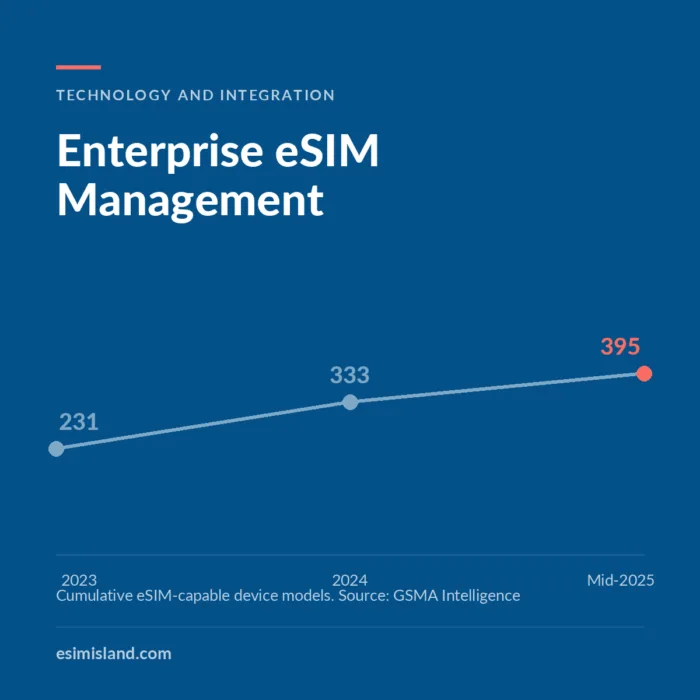
Cumulative eSIM-capable device models announced
Source: GSMA Intelligence device tracker, covering smartphones, tablets and smartwatches. 62 new eSIM devices were announced in the first half of 2025 alone.
Sources: GSMA Intelligence; GSMA Mobile Economy Report 2026; Kaleido Intelligence, 2026.
GSMA Intelligence counted 395 eSIM-capable device models as of mid-2025, up from 333 in 2024 and 231 in 2023, with 62 new models announced in the first half of 2025 alone. The GSMA Mobile Economy Report 2026 forecasts eSIM reaching around 42% of all SIM technologies by 2030, with 2.5 billion smartphone connections by 2028.
For a mobility team the useful reading is not that a large market is arriving. It is that your device estate is becoming eSIM-capable by default through ordinary refresh cycles, whether or not you have a plan for it. The question shifts from whether to adopt to who administers it and under what policy.
What a management platform needs to do
Most platforms can issue a profile. The differences that matter at scale are in lifecycle, policy and reporting.
| Capability | What to require | Why it matters at scale |
|---|---|---|
| Bulk provisioning | Issue and assign profiles in batches, via dashboard and API | Onboarding fifty people one at a time does not scale |
| Lifecycle control | Assign, reassign, suspend, retire without touching the device | Staff churn and role changes are continuous, not occasional |
| Policy and caps | Data limits per user, team or trip, with alerts and approval flows | This is what prevents bill shock, which is what ends contracts |
| Real-time usage | Current consumption per profile, not a daily batch file | A cap you learn about after the fact is not a control |
| Cost centre reporting | Usage grouped the way finance already groups it | Reports finance cannot reconcile create manual work, not savings |
| Diagnostics and reissue | See profile state; reissue without escalating to the supplier | Every failed install otherwise becomes a ticket you cannot close |
| Role-based access | Different permissions for IT, finance and regional managers | Delegation is how administration stops being a bottleneck |
Two rows carry more weight than the rest. Real-time usage is what turns a cap into an actual control rather than a number in a contract; a limit you learn about in a monthly file has already been exceeded. And cost centre reporting decides whether finance experiences this project as a saving or as a new reconciliation task. Reports that do not map to the structures finance already uses create work rather than removing it.
Policy is the part people skip
The technical rollout is usually straightforward. The conversations that determine whether it succeeds are about who is allowed to spend what, and who decides.
Four questions need answers before deployment, and they need them from finance and HR rather than IT alone. What is the data allowance per user or per trip? What happens when someone reaches it, and who can authorise more? Which destinations are enabled by default, and which need approval? And who, in each region, can assign or retire a profile without a central request?
Settling these in advance is what prevents the two failure modes that end managed connectivity arrangements: an unexpected bill that nobody agreed to, and an approval bottleneck that makes the new process slower than shipping SIM cards was.
Rolling out across a mixed estate
Almost no organisation has a uniformly eSIM-capable fleet. Planning for a mixed estate from the start is the difference between a phased migration and a stalled one.
Audit device eligibility first
Establish how much of the estate supports eSIM and whether any handsets are carrier-locked. This single step prevents most stalled rollouts. Expect a mixed picture and plan around the refresh cycle rather than against it.
Segment the workforce by travel pattern
Frequent multi-country travellers, occasional single-destination travellers, permanently remote staff and connected devices all need different plans. A single company-wide package overspends on one group and underserves another.
Agree the policy before the technology
Data caps, which destinations are enabled, who approves overage and who can assign profiles. Settle this with finance and HR, not just IT, because they are the people who will be asked about it later.
Pilot with one team for a full travel cycle
Twenty to fifty users, running long enough to include real trips. You are testing activation success, support volume, whether reporting fits finance's structure, and whether the plan design matches actual usage.
Roll out in waves aligned to device refresh
Migrate eligible devices first and let the rest arrive naturally as hardware is replaced. Forcing a switch-over on an ineligible estate creates exceptions that take longer to manage than the old process did.
Review quarterly against actual usage
Plan fit drifts as travel patterns change. A quarterly review of spend, coverage and allowance sizing is where the savings are maintained rather than eroded.
Where enterprise rollouts go wrong
Why rollouts stall
- Device eligibility assumed rather than audited
- Carrier-locked handsets discovered mid-deployment
- No agreed overage policy, so the first large bill becomes a dispute
- Reporting that finance cannot map to cost centres
- Support available in one time zone while staff travel across all of them
- Plans designed from the rate card rather than from travel patterns
What good looks like
- Eligibility known before anything is promised
- Phased migration aligned to hardware refresh
- Caps and alerts agreed with finance in advance
- Usage visible by team and cost centre in real time
- Profiles assignable and retirable by regional admins
- A named escalation path for a traveller who cannot connect
The most common single mistake is designing plans from the supplier’s rate card rather than from how people actually travel. A sales team crossing three borders on one trip needs multi-country coverage. A field team returning to the same two countries every month needs something quite different. Buying one company-wide package because it was on the price list overspends on the second group and leaves the first switching profiles at every border.
Frequently asked questions
Bring your connectivity under central control
eSIM Island supplies business roaming with the Connect+ dashboard and API: bulk provisioning, per-user caps, real-time usage and cost centre reporting. Tell us your headcount, travel destinations and current roaming spend and we will prepare a proposal.
Book a Free DemoOr explore the Reseller Program, API Integration and Business Roaming.
Leave a Reply