
Every international conference runs on an assumption that quietly fails for most of the room: that delegates arrive connected. They do not. They arrive having crossed a city on airport wifi and hotel hotspots, unable to open the event app, find the venue or message the person they were supposed to meet.
Connectivity is one of the more straightforward problems an organiser can solve, and one of the few where a single decision covers hundreds of people. This is how it works commercially and operationally, including the mistake that makes most attempts pointless.
Why events are a good fit
- One organiser makes a single decision for hundreds of people.
- Delegates are international, arriving on a known date, to a known place.
- Your app, agenda and networking tools all assume connectivity that many delegates lack.
- Crew and staff need reliable data before the venue wifi is even switched on.
- Order sizes are the largest available anywhere in travel connectivity.
How delegates actually arrive
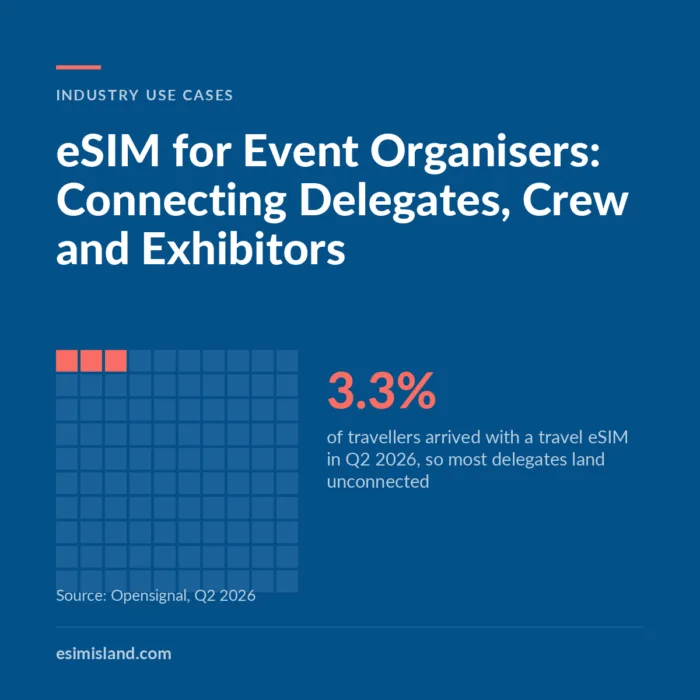
How delegates arrive: travel eSIM use among measured travellers, Q2 2026
Source: Opensignal global user base measurement, Q2 2026. The overwhelming majority of international delegates land with no data plan arranged.
Sources: Opensignal, Q2 2026; Kaleido Intelligence, 2026; GSMA Intelligence.
Opensignal measured travel eSIM use at 3.3% of travellers in the second quarter of 2026. Adoption is roughly doubling each year, which is fast, and it still means that for a conference of five hundred international delegates, the overwhelming majority land with nothing arranged.
That is why your event app underperforms, why the networking feature nobody uses stays unused, and why the first hour of registration is spent explaining the wifi password.
Six groups, six different needs
Treating everyone at an event as one audience is the most common planning error.
| Group | What they need | When they need it | Notes |
|---|---|---|---|
| International delegates | Modest data for the event days plus travel either side | From landing, before reaching the venue | The largest group and the easiest to serve |
| Speakers and VIPs | Reliable data, generous allowance | Throughout, including transfers | Small numbers, high consequence if it fails |
| Crew and production | Working data before venue wifi exists | Days before the event, during build | Often the group with the greatest actual need |
| Exhibitors | Data for stand staff and payment terminals | Build day through breakdown | A resale opportunity, not just a cost |
| Press | Upload capacity, reliability over volume | Live, during sessions | Failures here become public |
| Touring or multi-city events | Regional multi-country coverage | Across the whole tour | Best margin; multi-country plans price higher |
The crew row is the one organisers most often miss. Production teams are in a venue for days before wifi is commissioned, coordinating a build over mobile data that may be roaming at retail rates. They usually have the greatest operational need and the least attention paid to it.
Five ways to fund it
| Model | How it works | Commercial effect |
|---|---|---|
| Included in the ticket | Connectivity bundled into the delegate fee | Differentiates the event; cost absorbed into pricing |
| Registration upsell | Offered as an add-on during sign-up | Direct margin, and registration is the ideal moment |
| Sponsored connectivity | A sponsor funds delegate data in exchange for branding | Turns a cost into sponsorship inventory |
| Crew and staff allocation | Bulk profiles issued to the working team | Operational spend, usually already budgeted elsewhere |
| Exhibitor resale | Sold to exhibiting companies for their stand teams | Additional revenue from an audience already buying from you |
Sponsored connectivity is the model most organisers overlook and often the easiest to fund.
Sponsored connectivity deserves more consideration than it gets. It is genuinely useful rather than a branded tote bag, it is visible at the moment a delegate is most grateful, and it converts an operational cost into sponsorship inventory. For a telecoms, travel or technology sponsor it is an unusually natural fit.
Exhibitor resale is the other underused option. Exhibiting companies are already buying stand space, furniture and power from you, and their stand teams need reliable data for demonstrations and payment terminals. Adding connectivity to the exhibitor manual is a small amount of work for incremental revenue from an audience already transacting with you.
Getting the operations right
What makes it work
- Profiles issued against the registration list, in bulk
- Delivered with the joining instructions, not on arrival
- Install prompted while delegates are still at home
- Validity covering travel days either side of the event
- A named contact for delegates who cannot connect
- Spare capacity for late registrations and reissues
What goes wrong
- QR codes handed out at the registration desk, far too late
- Validity that expires before the last day
- No allowance for delegates on incompatible devices
- One person holding all the reissue requests
- Assuming venue wifi covers crew during build
- Multi-city events sold single-country plans
Validity is the second most common failure. An event running three days needs plans covering at least five, because delegates arrive early and leave late. A plan that starts on the first session morning is useless to someone who landed the previous afternoon and needed a taxi.
How to run it
Segment the list before you price anything
Delegates, speakers, crew, exhibitors and press need different allowances and different validity. Buying one uniform package for everyone overspends on delegates who barely use data and underserves the crew who need it most.
Issue with the joining instructions
The joining pack is the only communication every delegate reliably opens, and it reaches them while they are still on a home network. This is the single decision that determines whether the programme works.
Set validity to cover travel days
An event running Tuesday to Thursday needs plans valid from Monday to Friday at least. Delegates arriving a day early with an expired or not-yet-started plan is the most common complaint, and it is entirely avoidable.
Prioritise crew during build
Production teams work in a venue for days before wifi is commissioned. They are usually the group with the greatest operational need and the group most often forgotten in the connectivity plan.
Approach a sponsor before treating it as a cost
Connectivity is naturally brandable and genuinely useful, which makes it easy sponsorship inventory. A telecoms, travel or technology sponsor funding delegate data is a straightforward conversation.
Staff the first two hours of arrival
Almost all support volume lands in the window when delegates are travelling to the venue. Have someone briefed and reachable, with the ability to reissue a profile, for that window specifically.
Step six is worth staffing properly. Support demand in this category is heavily concentrated in the window between landing and arriving at the venue, and it is almost entirely install-related: an incompatible device, a code already used, or a profile installed correctly with data still routed to the home line. Someone briefed and reachable during that window resolves nearly all of it.
Frequently asked questions
Connect your delegates before they land
eSIM Island supplies event organisers and DMCs with bulk provisioning against a delegate list, regional plans for multi-city events, and wholesale rates for your host markets. Tell us your event size and destinations and we will prepare a proposal.
Book a Free DemoOr explore the Reseller Program, API Integration and Business Roaming.
Leave a Reply