
Search interest in the eSIM business opportunity has risen sharply, and most of the content answering it is written by people selling something. This assessment is written by a company that supplies the infrastructure, which is a conflict of interest worth stating openly. So rather than argue that everyone should start an eSIM business, this piece sets out what the data actually shows, where the money is genuinely made, what the real risks are, and which businesses should probably not enter at all.
The short version is that the opportunity is real and the category is growing quickly, but the returns are distributed very unevenly. The difference between a business that works and one that quietly loses money for a year comes down to a single factor, and it is not pricing, branding or technology.
The honest summary
- The demand is real and growing fast, but adoption is still low enough that most of the market has never bought a travel eSIM.
- Gross margins are strong because the product is digital. Net margins are decided almost entirely by acquisition cost.
- The generic global travel eSIM store is the hardest position in the category and the most crowded.
- The businesses winning are the ones that already own an audience, a corridor or a distribution channel.
- If you have no distribution advantage and plan to buy traffic, the numbers are difficult and getting worse.
How big is the eSIM business opportunity in 2026?
Two separate things are growing at once, and conflating them causes most of the bad analysis in this category. The first is eSIM adoption, meaning how many phones can use the technology and how many people have tried it. The second is travel eSIM spending, meaning how much money consumers actually hand over for travel data plans. The first is the addressable market. The second is the revenue pool.
On adoption, GSMA Intelligence put global eSIM smartphone penetration at around 5% at the end of 2025, forecast to double to roughly 10% by the end of 2026 and to double again during 2027. Two events removed the structural blockers: Apple extended its eSIM-only iPhone design into global markets in late 2025, and Chinese operators launched smartphone eSIM services for the first time.
Sources: Kaleido Intelligence, 2026; Opensignal Q2 2026; GSMA Intelligence.
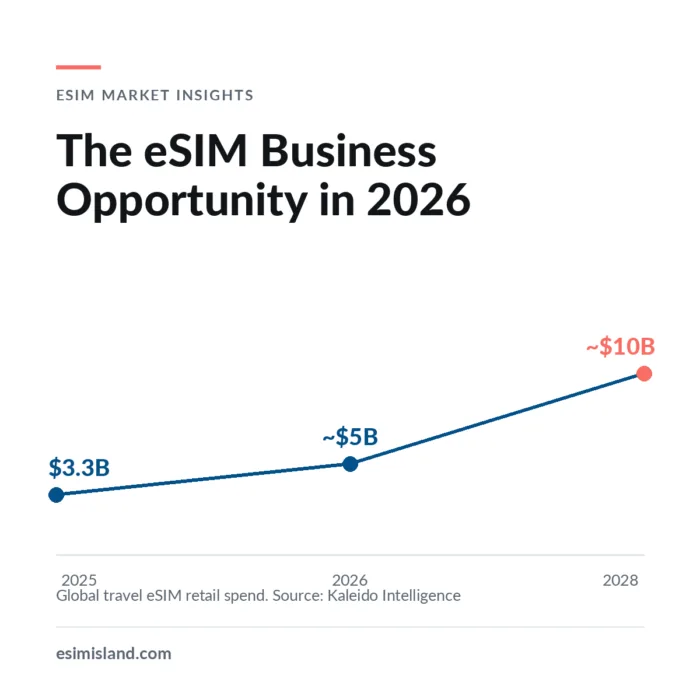
On spending, Kaleido Intelligence tracked travel eSIM retail spend at $3.3 billion in 2025 and expects it to approach $5 billion in 2026, reaching close to $10 billion by 2028. At that point travel eSIM is forecast to account for over 80% of all travel SIM spend and around 28% of total travel connectivity spend including roaming.
Global travel eSIM retail spend
Source: Kaleido Intelligence. By 2028 travel eSIM is forecast to represent over 80% of all travel SIM spend and around 28% of total travel connectivity spend.
Those are large numbers and they are frequently quoted without the qualifier that matters. The revenue pool is growing because spending per customer is rising, not only because more customers are arriving. Both are happening, but the second is slower than the headlines suggest.
The number that reframes the opportunity
Opensignal measured travel eSIM users across its global base at 1.7% in the second quarter of 2025, rising to 3.3% a year later. That is close to a doubling in twelve months, which is genuine and fast growth. It also means that as of mid-2026, roughly 97 out of every 100 travellers were still not using a travel eSIM.
Travel eSIM share of measured travellers
Source: Opensignal global user base measurement, Q2 2026. Operator roaming lost 5.2 percentage points of traveller share over the same period.
Operator roaming lost 5.2 percentage points of traveller share over the same period, which tells you where the growth is coming from. This is a substitution story: travel eSIM is taking revenue directly out of a large, established and highly profitable operator business.
The practical consequence is that customer education is part of the job. A meaningful share of your addressable audience does not know what an eSIM is, is not sure their phone supports one, and has a vague worry about being disconnected in a foreign country. That friction is not a marketing message problem; it is a cost line, and it shows up as support tickets, refunds and abandoned checkouts.
Where the money is actually made
An eSIM business earns the spread between the wholesale rate it pays for data and the retail price of a packaged plan. There is no cost of goods beyond the data itself, no shipping and no inventory. Gross margins are structurally strong across the whole category, which is precisely why gross margin is a useless number for comparing one eSIM business against another. Everyone has good gross margins. Almost nobody has good net margins.
What separates them is customer acquisition cost measured against average order value. The category average spend per trip is around $28. If it costs you $25 to acquire a customer who spends $28, you have a hobby. If it costs $4 because they came from your own booking flow, you have a business.
Average spend per trip, 2026
Source: Kaleido Intelligence traveller survey, 2026. 15% of travel eSIM buyers now choose unlimited plans.
The encouraging half of that chart is the direction. Average travel eSIM spend per trip rose 133% year on year to around $28, while roaming spend per trip fell 9% to around $42. Customers are buying larger allowances and longer validity, and 15% now choose unlimited plans. A category with rising average order value gives a new entrant considerably more room than one competing to be cheapest.
The sobering half is the gap that remains. Roaming still extracts $42 per trip against travel eSIM’s $28, which tells you the incumbent is still capturing more value per customer despite losing share.
Three ways in, and how their economics differ
Almost every entrant takes one of three routes. They are not equally viable, and the difference is visible in the first ninety days.
| Paid-traffic store | Audience-led brand | Embedded in a booking flow | |
|---|---|---|---|
| Where customers come from | Bought at auction | Owned audience and content | Existing checkout |
| Acquisition cost | High and rising | Low after build-up | Near zero |
| Time to first sale | Days | Months | Weeks after integration |
| Contribution on first order | Thin or negative | Healthy | Strong |
| Defensibility | Low | Moderate to high | High |
| Main failure mode | Auction costs outrun order value | Audience never reaches scale | Integration stalls or partner churns |
Qualitative comparison of the three routes most new entrants take. Figures for the underlying unit economics are worked through in our launch roadmap.
The paid-traffic store is the most common starting point and the hardest to make work. You are bidding in an open auction against funded incumbents on an average order value under $30, and auction costs rise as the category matures rather than falling. It can work as a testing channel to validate messaging quickly. As a primary volume channel at this order value it is difficult.
The audience-led brand takes longer but compounds. If you already publish content, run a community, or serve a specific corridor, you can acquire customers at a fraction of auction cost and build a repeat base that is genuinely yours.
Embedded distribution is the strongest position available. Offering connectivity inside a booking confirmation or travel app reaches the customer at the exact moment of need, through a brand they already trust, at close to zero incremental acquisition cost. This is why airlines, agencies and booking platforms are the most commercially interesting entrants in the category, and why the reseller model exists in the first place.
The risks, assessed honestly
Every category write-up lists risks. Most list them without saying which ones actually matter. Here is an assessment of each.
| Risk | How real it is | What reduces it |
|---|---|---|
| Price compression | Real but overstated. Average spend per trip rose 133% in 2026, so the category is trading up rather than racing to zero. | Sell multi-country and unlimited plans; compete on experience rather than price per gigabyte |
| Rising acquisition cost | The most serious risk. Paid auctions get more expensive as funded incumbents scale. | Own a distribution channel; build on an existing audience; embed in a booking flow |
| Operator counter-attack | Significant. 89% of travellers say they would rather buy from their home operator. | Serve corridors and segments operators ignore; sell B2B where operators are weak |
| Commoditisation of supply | High. Many resellers buy from the same aggregators and sell identical plans. | Choose a provider that lets you build custom packages rather than resell fixed ones |
| Regulatory change | Moderate and market-specific. Some countries mandate identity checks or local registration. | Confirm requirements per market before launch; build KYC into checkout where required |
| Support burden | Underestimated by most entrants. Failures happen when the customer is abroad and offline. | Compatibility checks before payment; dual-platform instructions; dashboard diagnostics |
If you read only one row, read the second. Acquisition cost is the risk that kills eSIM businesses, and it kills them slowly enough that founders often do not notice for two or three quarters. The others are manageable with the right provider agreement and reasonable operational discipline.
The trust gap deserves a note of its own. Kaleido found that 89% of travellers would prefer to buy a travel eSIM from their existing home operator, while only 60% would buy from a dedicated travel eSIM provider. That is a substantial structural disadvantage for any independent brand, and it is the single strongest argument for distributing through an existing trusted brand rather than building a new one from scratch.
Who should and should not enter this market
The honest answer is that this is an excellent business for some companies and a poor one for others, and the dividing line is distribution rather than capital, skill or timing.
Well positioned
- Travel agencies and tour operators with booking flow and repeat customers
- Airlines, OTAs and booking platforms who reach travellers at the moment of need
- Apps and fintechs with an existing international user base
- Diaspora and community brands with trust in a specific corridor
- IT resellers and MSPs already selling to corporate buyers
- Anyone with a real audience in a defined travel niche
Poorly positioned
- A generic global store with no audience and a paid search budget
- Anyone expecting passive income with no operational involvement
- Businesses planning to compete purely on being cheapest
- Anyone who cannot fund three to six months of acquisition testing
- Operators unwilling to handle support during a customer's trip
If you are on the right-hand list, the correct response is not necessarily to abandon the idea. It is to solve distribution first. Build the audience, secure the partnership, or find the corridor, and then launch. Launching first and hoping to work out distribution afterwards is the pattern that produces most of the failures in this category.
How to test the opportunity before committing
The good news is that testing this properly is cheap. The technology is not the expensive part and never has been, which means you can answer the important questions for a few hundred dollars and a few weeks.
Name the corridor or segment, not the world
Write down exactly who you intend to sell to: which origin market, which destinations, which type of traveller. If you cannot describe them in one sentence, you do not have a position yet and everything downstream will be guesswork.
Prove you can reach them before you build anything
Run a small content or partnership test aimed at that audience and measure whether you can get their attention at a sensible cost. This costs a few hundred dollars and answers the only question that actually matters.
Get real wholesale pricing for your destinations
Sign an NDA and request a rate card for your specific countries and expected volumes. Until you know your landed cost per gigabyte, any margin projection is fiction.
Model the contribution, not the gross margin
Subtract acquisition, processing and a support and refund allowance from your retail price. If the first order barely contributes, check that your repeat rate assumption is defensible before proceeding.
Launch narrow and measure three numbers
Cost per sale, activation success rate and repeat purchase rate. These three tell you whether the business works. Everything else is noise in the first ninety days.
Decide honestly at ninety days
If cost per sale is above contribution and repeat purchase is not compensating, the answer is to change the channel or the segment, not to spend more on the same one.
The discipline that matters here is step six. A category growing at this rate produces a strong temptation to attribute poor early results to insufficient spend. Sometimes that is correct. More often it means the channel or segment is wrong, and increasing the budget makes the loss larger rather than fixing it.
What the opportunity looks like in three years
Extrapolating the current data, three things look likely. Adoption continues climbing, with GSMA Intelligence forecasting 4.9 billion eSIM smartphone connections by 2030, about 55% of all smartphone connections. The revenue pool roughly doubles again, on Kaleido’s trajectory towards $10 billion by 2028. And operators respond seriously, because losing 5.2 percentage points of traveller share in a year is not a trend any carrier ignores indefinitely.
That third point is the one most business plans omit. If operators build competitive travel eSIM products and market them to their existing base, they start from an 89% trust advantage. The independent brands that survive that will be the ones with a genuine distribution position or a segment operators find uneconomic to serve.
Which points at where the durable opportunity sits: not in being another global travel eSIM store, but in embedding connectivity into businesses that already own travel demand, and in serving corridors, languages, verticals and corporate accounts that large operators treat as too small to bother with.
Frequently asked questions
Get real pricing before you build a business plan
The only way to know whether the numbers work for your markets is to see an actual rate card. Tell eSIM Island your target countries and expected volumes and we will prepare a wholesale pricing proposal you can model against.
Book a Free DemoOr explore the Reseller Program, API Integration and Business Roaming.
Leave a Reply