
This is a narrow comparison for people who have already decided against a plain white-label store and are weighing whether to go further. If you are still choosing between the four ways into this market, our guide to the types of eSIM business covers the broader picture.
The distinction here is legal and structural rather than commercial. A reseller sells connectivity that somebody else is licensed to provide. An MVNO becomes that somebody. Everything else, the capital, the timeline, the obligations and the risk, follows from that single difference.
The short answer
- A reseller sells connectivity someone else is licensed to provide. An MVNO becomes the licensed provider.
- Weeks and a few thousand dollars against months to years and substantial capital.
- An MVNO is only correct when controlling the network stack is the strategy, not a preference.
- Most businesses that think they need an MVNO actually need a provider who lets them build their own packages.
- Starting as a reseller does not prevent becoming an MVNO later, and it funds the decision with real data.
What actually separates the two
The customer usually cannot tell the difference. Both sell a data plan that arrives as a QR code and works abroad. The difference sits entirely behind the product, and it determines what you can build and what it costs you to get there.
| eSIM reseller | Full MVNO | |
|---|---|---|
| Carrier agreements | None; your partner holds them | You negotiate directly with host networks |
| Core platform | Your partner's | Yours to build, buy or licence |
| Telecom licence | Usually not required | Required, with ongoing obligations |
| Numbering | Not applicable for data-only | Typically allocated and administered by you |
| Capital | Low; a few thousand dollars is workable | High; platform, integration, compliance and staffing |
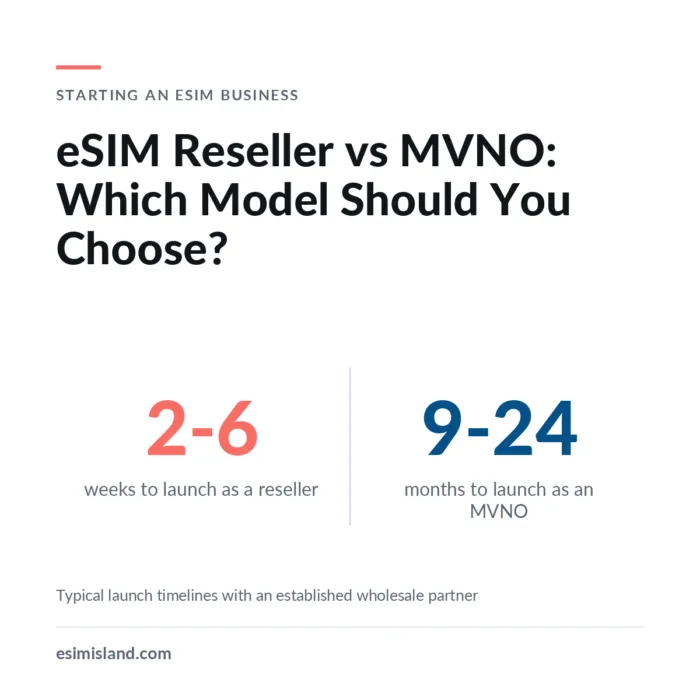
| Time to first sale | 2-6 weeks | 9-24 months |
| Fixed cost if you sell nothing | Near zero | Continues regardless |
| Control over the product | As much as your partner allows | Complete |
| Margin ceiling | Set by your wholesale rate | Higher, once volume covers fixed costs |
| Who you compete with | Other resellers | Operators |
The row worth dwelling on is fixed cost. A reseller who stops selling stops spending. An MVNO carries platform, compliance and staffing costs whether the month was good or not. That asymmetry is what makes the decision consequential rather than merely strategic.
Source: GSMA Mobile Economy Report 2026.
The timeline gap
Time to first revenue is the most concrete difference and the one most often underestimated.
Time from decision to first paying customer
Typical durations with an established wholesale partner versus a full MVNO build. Actual timelines vary by market, regulator and integration depth.
Two to six weeks against nine to twenty-four months is not a difference of degree. It changes what kind of business you are running in year one. The reseller spends that year learning what customers want and refining an offer against real feedback. The MVNO spends it in negotiation, integration and regulatory process, and learns nothing about demand until the end of it.
In a category where eSIM is forecast to reach around 42% of all SIM technologies by 2030 and 2.5 billion smartphone connections by 2028, spending the next two years building rather than selling has a real opportunity cost.
When an MVNO is actually the right answer
There is a genuine case for building one, and it is worth stating clearly rather than dismissing.
An MVNO is genuinely right when
- Connectivity is your core business, not an addition to it
- You need capabilities no aggregator will provide
- Voice, SMS and your own numbering are essential to the product
- Your volume is large enough that wholesale margin is the binding constraint
- You are funded for a multi-year build with no revenue in year one
- Regulatory capacity exists in-house or is budgeted for
Reasons that are not good enough
- "We want to own the customer" - resellers own the customer too, if the contract says so
- "We need better margins" - negotiate volume rates first
- "We want our own packages" - pick a partner who allows custom packages
- "It sounds more credible" - customers cannot tell and do not ask
- "We do not want to depend on a supplier" - an MVNO depends on host networks instead
The left-hand list has a common thread: control of the stack is the strategy itself, not a means to a commercial end that could be reached another way. The right-hand list contains the reasons most often given, and almost all of them are solvable without a licence.
What people actually want when they ask about MVNOs
In practice, the MVNO question is usually a proxy for something more specific. It is worth translating.
| What you actually want | What you think you need | What usually solves it |
|---|---|---|
| Custom data allowances and validity windows | An MVNO | A partner whose platform lets you build packages rather than resell fixed plans |
| Better rates at higher volume | An MVNO | Renegotiating your wholesale rate once you have real volume to show |
| Multi-country plans nobody else offers | An MVNO | Custom country combinations in your partner's dashboard |
| Owning the customer relationship and data | An MVNO | Contract terms confirming you hold the customer record and can leave with it |
| Real-time usage and automated billing | An MVNO | API access with webhooks and usage reporting |
| Voice and SMS under your own numbers | An MVNO | Genuinely an MVNO, or a specialist partner; this one is real |
Most stated reasons for building an MVNO are solvable inside a reseller agreement. The last row is the common exception.
The voice and SMS row is the honest exception. If your product genuinely requires your own numbering, calls and messages rather than data with calling over IP, the reseller route will not get you there and an MVNO or a specialist partner becomes necessary. Most travel connectivity products do not need this, which is why the majority of travel eSIM offers are data only.
A sequence that keeps both options open
Starting as a reseller does not close the door on becoming an MVNO. It funds the decision and replaces assumptions with numbers.
Start as a reseller and sell something
Prove there is demand at a price that works before committing capital. Weeks, not years, and the cost of being wrong is a few thousand dollars rather than a funding round.
Measure the three numbers that matter
Cost per sale, activation success rate and repeat purchase rate. These tell you whether the business works. Volume alone does not.
Renegotiate your wholesale rate at volume
Once you have real traffic, your rate card is negotiable. Many businesses that considered an MVNO for margin reasons find a renegotiated reseller rate closes most of the gap without any of the capital.
Identify what you still cannot do
Write down the specific capabilities your partner cannot provide. If that list is short and commercial, change partner. If it is long and structural, you have a real case.
Model the fixed cost against your actual volume
An MVNO's costs continue whether you sell or not. Take your measured volume and margin, not your forecast, and check whether it covers a platform, integration, compliance and the staff to run them.
Only then commit
By this point the decision is made on evidence rather than ambition, and you have a running business funding it rather than a plan competing for capital.
Step three surprises people most often. Wholesale rates are not fixed prices; they are negotiated positions that improve as your volume becomes worth having. A business arriving with twelve months of measured traffic is in a materially different negotiation than one arriving with a forecast, and the improved rate frequently removes most of the margin argument for building an MVNO at all.
Frequently asked questions
Get the reseller terms before you cost an MVNO
Before committing to a multi-year build, see what a wholesale agreement actually offers: custom packages, API access, real-time usage and rates priced for your markets. Tell eSIM Island your target countries and volumes and we will put a proposal together.
Book a Free DemoOr explore the Reseller Program, API Integration and Business Roaming.
Leave a Reply