
“Which countries should I target?” is the question most new eSIM businesses ask first, and it is slightly the wrong question. The market with the most travellers is also the market with the most competitors bidding for them, and the country with the highest eSIM adoption is usually where the funded players concentrate their budgets.
The better question is which market you can be genuinely better in. This is a framework for answering that, with the current regional data, the criteria that actually predict success, and an argument for why corridors beat countries.
Before you pick a country
- The best market is rarely the biggest one. It is the one where you have an advantage.
- High adoption means high competition. Mid-curve markets often have better economics.
- Corridors beat countries: an origin-destination pair is far easier to own than a nation.
- Long-haul and multi-country travellers convert best, so route matters more than population.
- Language, payment methods and local trust signals decide conversion more than coverage does.
What makes a market attractive
Six factors matter, and population is not one of them.
| Criterion | What to look for | Why it matters |
|---|---|---|
| Device eligibility | Share of handsets that support eSIM in that market | No amount of marketing works on phones that cannot install a profile |
| Outbound travel volume | How many people leave the country, and how far | Long-haul travellers are 2.5 times more likely to buy a travel eSIM |
| Trip shape | Single-destination or multi-country journeys | Multi-country travellers convert 1.5 times better and support premium pricing |
| Roaming alternatives | Whether local operators bundle cheap or free roaming | Regions with roam-like-at-home pricing remove your saving on intra-regional trips |
| Payment and language | Local payment methods, local-language support | Usually the largest conversion lever, and where incumbents are weakest |
| Competitive density | How many providers already target that audience | Determines your acquisition cost more than any other factor |
Sources: GSMA Intelligence; Kaleido Intelligence, 2026; GSMA consumer research.
The two behavioural factors deserve emphasis because they are frequently overlooked. Kaleido found long-haul travellers are around 2.5 times more likely to use a travel eSIM than short-haul ones, and multi-country travellers 1.5 times more likely. A market whose residents mostly take short single-destination trips will convert structurally worse than one whose residents fly long-haul, regardless of how large it is.
Where adoption actually stands by region
Global penetration figures hide differences of several years between regions.
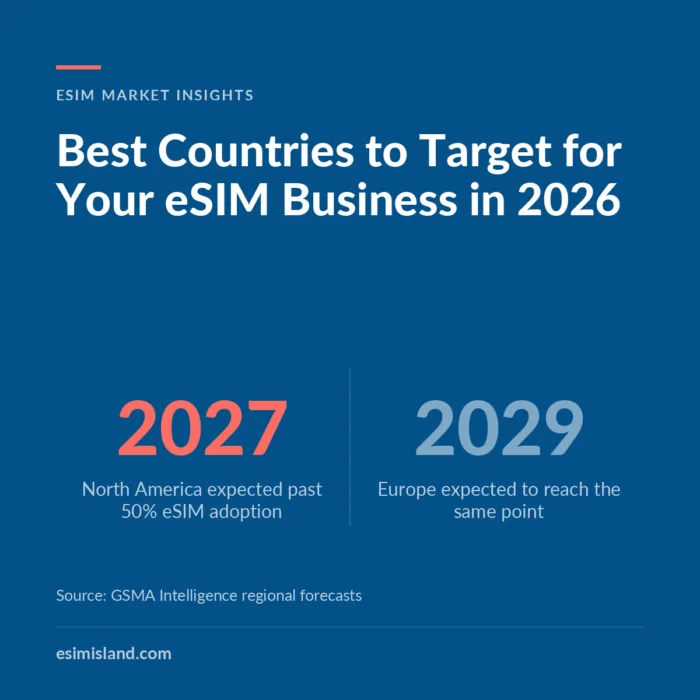
Expected year to pass 50% eSIM smartphone adoption
Source: GSMA Intelligence regional adoption forecasts. The two-year gap reflects eSIM-only iPhones shipping in the United States since 2022.
GSMA Intelligence expects North America to pass 50% eSIM smartphone adoption by 2027 and Europe around 2029. That two-year gap is largely explained by eSIM-only iPhones shipping in the United States since 2022. Globally, penetration is forecast to double from roughly 5% at the end of 2025 to around 10% by the end of 2026.
The markets worth considering
| Market type | Examples | Adoption | Competition | What wins here |
|---|---|---|---|---|
| Mature | United States, Canada | Highest; expected past 50% by 2027 | Very high | Distribution partnerships or a vertical nobody serves |
| Large, under-converted | United Kingdom, Germany, Netherlands | Rising; Europe expected past 50% around 2029 | High | Clearer pricing and better landing pages than incumbents |
| Mid-curve, high growth | Gulf states, Southeast Asia, Central and Eastern Europe | Growing fast from a lower base | Moderate | Local language, local payment methods, local trust |
| Volume markets | India, Indonesia, Brazil | Large base, uneven device support | Moderate to high | Affordability and distribution through local platforms |
| Emerging entrants | China | Smartphone eSIM launched late 2025 | Structurally difficult for outsiders | Local partnerships; hard to serve from outside |
Adoption reflects GSMA Intelligence regional forecasts. Competition is an assessment of observed provider concentration rather than a published figure.
China deserves a specific note. Chinese operators launched smartphone eSIM services in late 2025, opening a market previously limited to wearables and IoT, and it is widely expected to become the largest by volume given the subscriber base and device manufacturing. It is also structurally difficult to serve from outside without local partnerships, so for most new entrants it is a market to watch rather than to target.
Global travel eSIM retail spend
Source: Kaleido Intelligence. Growth is global, but it is not evenly distributed across markets.
Kaleido Intelligence expects travel eSIM retail spend to approach $5 billion in 2026 and close to $10 billion by 2028. That growth is real but unevenly distributed, which is precisely why picking where to compete matters more than the headline size of the category.
Why corridors beat countries
A country is not an audience. “Outbound travellers from the United Kingdom” describes tens of millions of people with nothing in common except a passport. A corridor describes a specific group who travel the same route, often share a language or community, and can be reached through the same channels.
| Approach | What you target | Cost to win | Defensibility |
|---|---|---|---|
| Global | Everyone, everywhere | Highest; open auction against funded incumbents | None |
| Country | All outbound travellers from one market | High; still a broad, contested audience | Low |
| Corridor | One origin-destination pair with real volume | Moderate; reachable through specific communities | Good |
| Vertical | A traveller type with an operational need | Low; small, findable audiences | Strong |
| Embedded | Customers already in a booking or app flow | Lowest; near-zero incremental acquisition | Strongest |
Corridors also solve the trust problem more cheaply than advertising does. Travellers on a well-defined route usually have places they already go for information about it: community groups, forums, agencies, creators who cover that destination. Being present and credible there costs a fraction of what the equivalent attention costs at auction.
How to choose your first market
Start from your own advantage, not the map
List the markets where you already have something: an audience, a language, a partner, a community, a corporate relationship. If one exists, it beats any market you would have to enter cold, regardless of its size or adoption rate.
Pick a corridor rather than a country
Name an origin and a destination with real volume between them. A corridor gives you a specific audience reachable through specific channels, shared language and shared payment habits, none of which apply to "outbound travellers from Germany".
Check the roaming baseline in that origin market
If travellers from there already get cheap or bundled roaming for the destinations they visit, your saving disappears. This is the reason intra-regional travel in some markets is poor territory even where adoption is high.
Get wholesale rates for those specific destinations
Rates vary enormously by country for structural reasons. A corridor that looks attractive commercially can be unprofitable if your partner has a weak position in the destination market, and you will not know until you see the rate card.
Test reachability before you build anything
Spend a small amount trying to reach that specific audience through content, community or partnership. You are answering one question: can you get their attention at a sensible cost? Everything else follows from the answer.
Add the second market only after the first works
Expanding before the first corridor is profitable spreads a limited budget across two audiences you understand equally poorly. Prove one, then reuse what you learned.
Step three is the one most often skipped and it can invalidate an otherwise sensible choice. Where regional roaming arrangements already give travellers cheap or bundled data across neighbouring countries, the core value proposition of a travel eSIM is much weaker for those journeys. That does not rule the market out; it means your opportunity there is in long-haul departures rather than regional trips, which changes which destinations you price aggressively and what your marketing says.
Frequently asked questions
Get rates for the markets you are considering
Wholesale rates differ too much by country for a general answer to be useful. Tell eSIM Island the corridors you are looking at and we will send per-country pricing, the carriers behind it, and an honest view of where the economics work.
Book a Free DemoOr explore the Reseller Program, API Integration and Business Roaming.
Leave a Reply