
“How much does it cost to start an eSIM business?” has a short answer and a useful answer. The short one is a few thousand dollars, which is true and close to meaningless. The useful one is that setup costs are the smallest part of what you will spend, and treating them as the budget is the most common planning error in this category.
This sets out what you actually need to pay for, what dominates the real budget, and how the picture changes completely depending on whether you already have an audience.
The honest summary
- Setup is cheap. A few thousand dollars covers everything you need to start selling.
- That figure is not the budget. Customer acquisition is, and it dominates everything else.
- Plan for acquisition spend several times larger than every setup cost combined.
- Anyone quoting a single startup figure is describing the smallest part of the problem.
- If you already have an audience, the real budget collapses. If you do not, it does not.
What you actually have to pay for
The setup list is short, and I have deliberately left figures off it. Costs vary enormously by jurisdiction and provider, and published ranges tend to be either marketing or guesswork.
| Item | Necessary? | What drives the cost |
|---|---|---|
| Company registration | Usually yes | Jurisdiction; varies from nominal to substantial |
| Domain and brand | Yes | Whether you buy an existing domain or register a new one |
| Storefront | Yes | White-label store included by some providers; otherwise build or subscribe |
| Payment processing | Yes | Usually no setup fee, but per-transaction fees erode a $28 order |
| Wholesale agreement | Yes | Often no minimum commitment; verify before assuming |
| Initial data purchase | Sometimes | Prepaid balance if required; many programs bill in arrears |
| Legal and terms | Yes | Refund policy for a digital product; consumer terms |
| Tax registration | Depends | Cross-border digital sales may create obligations; take advice |
| Test devices | Yes if integrating | Real iOS and Android handsets; emulators cannot install profiles |
Deliberately without figures, because they vary enormously by jurisdiction and provider. Price these against your own situation rather than a published range.
Source: Kaleido Intelligence, 2026.
Two rows deserve comment. Many reseller programs carry no minimum data commitment, so a provider demanding a large deposit before you have sold anything is transferring risk to you and should be offering materially better terms in exchange. And test devices are a real line item if you are integrating, because eSIM profile installation cannot be exercised in an emulator.
What the budget is actually spent on
None of the items below appear in a typical startup cost article, and together they dwarf the setup list.
| Cost | Why it dominates | How to control it |
|---|---|---|
| Customer acquisition | Paid channels are contested by funded competitors on a $28 order | Own an audience, a corridor or a partnership before spending |
| Payment fees | A fixed fee plus percentage is material on a small order | Encourage larger plans and top-ups; check regional pricing |
| Refunds and failed activations | Preventable, but real from day one | Compatibility checks before payment; clear activation instructions |
| Support | Concentrated at first install, across time zones | Better instructions reduce volume more than more staff do |
| Working capital | You may pay for data before customers pay you | Understand billing terms before committing to volume |
| Your time | Never in the spreadsheet, always the largest input | Cost it honestly before deciding this is a side project |
Average travel eSIM spend per trip
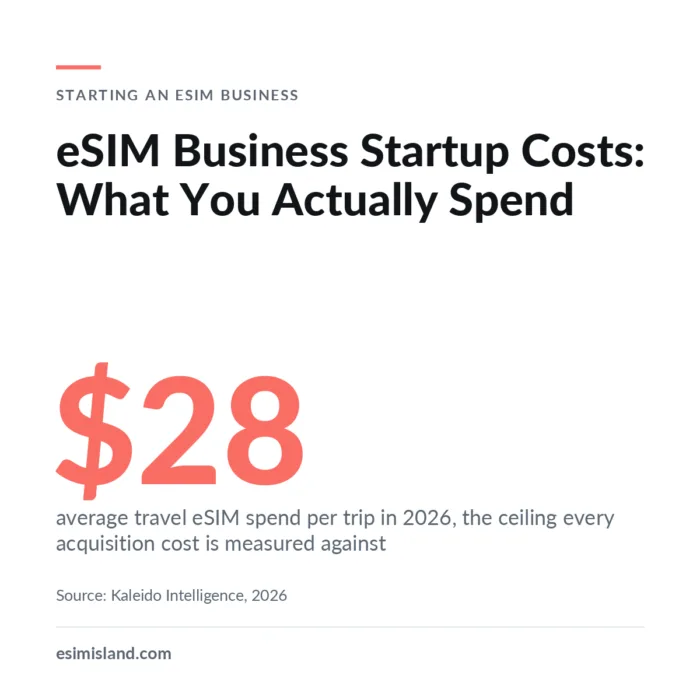
Source: Kaleido Intelligence, 2026, which reported spend per trip up 133% year on year to around $28. The 2025 figure is implied by that growth rate. This is the number every acquisition cost must be measured against.
The arithmetic is unforgiving and worth stating plainly. Average travel eSIM spend per trip was around $28 in 2026. After wholesale cost, payment fees and an allowance for refunds and support, what remains is your budget for finding that customer. In contested paid channels, competing against funded providers, that budget is frequently insufficient on a first order.
The businesses that work in this category are not the ones with cheaper storefronts. They are the ones that reach customers without paying at auction, whether through an existing audience, a defined corridor, a community or an embedded position in someone else’s booking flow.
Two completely different budgets
If you already have an audience
- Setup costs are most of your budget
- Acquisition is close to zero for early customers
- You can test demand within weeks
- Contribution per sale is healthy from the start
- The main risk is operational, not financial
If you are starting cold
- Setup costs are a rounding error
- Acquisition is the entire business problem
- Expect months of testing before unit economics work
- First orders may contribute little or nothing
- Budget for being wrong several times
If you fall on the right-hand side, that is not a reason to abandon the idea. It is a reason to solve distribution before launching rather than after. Build the audience, secure the partnership, or pick a corridor you can reach cheaply, and the budget on the left becomes available to you.
How to budget properly
Work out your contribution per sale first
Take a realistic retail price, subtract the wholesale cost, payment fees and an allowance for refunds and support. What remains is what you have to spend on acquiring a customer. Do this before anything else, because it determines whether the business is viable at all.
Get real wholesale rates before modelling
Rates vary substantially by country and by volume. Any margin projection built before you have seen a rate card for your actual destinations is guesswork, and usually optimistic.
Establish whether a minimum commitment applies
Many reseller programs have no minimum data commitment. If a provider requires a deposit or minimum before you have proven demand, that is a risk transfer to you, and it should buy materially better terms.
Budget acquisition as a multiple of setup
A useful planning rule is that acquisition spend should be several times every setup cost combined. If you cannot fund that, the answer is not a cheaper storefront; it is finding distribution that does not require paid acquisition.
Hold back working capital
Depending on billing terms you may pay for data before customers pay you, and refunds arrive faster than payouts. Reserve for that rather than spending your whole budget on launch.
Measure three numbers for ninety days
Cost per sale, activation success rate and repeat purchase rate. These tell you whether to scale, adjust or stop, and no amount of planning substitutes for them.
Step one is the whole exercise compressed. Most business plans in this category calculate gross margin, find it healthy, and stop. Gross margin is healthy for everyone here, because a digital product has no cost of goods beyond the data. Contribution after acquisition, processing and support is the number that separates a business from an expensive hobby, and it takes ten minutes to calculate.
Frequently asked questions
Start with real numbers, not estimates
eSIM Island provides wholesale rates for your specific destinations and volumes, with no minimum data commitment, so you can model contribution properly before committing. Tell us your target markets and we will send pricing.
Book a Free DemoOr explore the Reseller Program, API Integration and Business Roaming.
Leave a Reply