
If you already run a business that touches travellers, adding connectivity under your own name is one of the more sensible extensions available. The product is digital, the supply side is solved, and your customers are already having the problem it fixes. The question is not usually whether to do it, but whose name goes on it.
There are three answers. Put it under your existing brand, create a separate sub-brand, or co-brand with your supplier. They lead to genuinely different businesses, and the right choice depends less on ambition than on one measurable thing: whether your brand already means something to travellers.
The decision in short
- Sub-brand, co-branded and white label are three different answers to the same question: whose name is on the product.
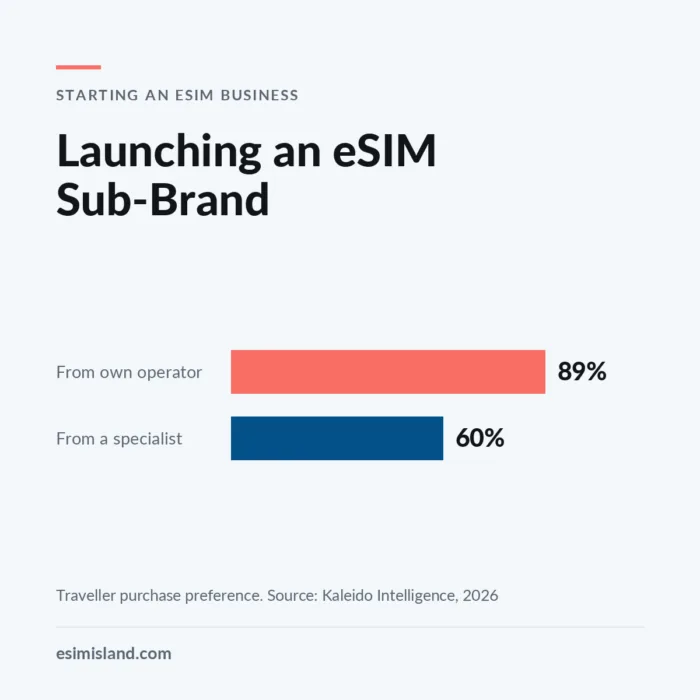
- The trust gap decides it. 89% of travellers would rather buy from a brand they already use than from a specialist they do not.
- Co-branding borrows credibility fastest but caps how much of the relationship you own.
- A sub-brand costs more to establish but keeps the customer, the data and the pricing power.
- Pick based on whether your existing brand already means something to travellers, not on which sounds more ambitious.
Why an established brand has the advantage here
The travel eSIM category has a structural problem that rarely gets stated plainly. Buying mobile data for another country involves handing money to a company you have never heard of, in exchange for something you cannot verify until you land. That is a lot of trust to ask from a first-time buyer.
Where travellers say they would rather buy a travel eSIM
Source: Kaleido Intelligence traveller survey, 2026. The 29-point gap is the commercial case for putting connectivity under a brand the customer already trusts.
Kaleido Intelligence found that 89% of travellers would prefer to buy a travel eSIM from a provider they already have a relationship with, while only 60% would buy from a dedicated specialist. For independent eSIM startups, that gap is the central obstacle. For a business that already has travellers as customers, it is the reason to enter at all.
Sources: Kaleido Intelligence, 2026; GSMA consumer research.
The second advantage is timing. GSMA research found 51% of eSIM users first tried the technology while travelling abroad. If you sell flights, tours, accommodation, insurance or anything else attached to a trip, you already reach the customer at the exact moment connectivity becomes relevant, which is the hardest moment for a standalone brand to buy its way into.
Sub-brand, co-branded or your own name?
These are often discussed as if they were degrees of the same thing. They are not. They differ in who owns the customer, how much trust transfers on day one, and how much risk lands on your parent brand when something goes wrong.
| Under your main brand | Separate sub-brand | Co-branded | |
|---|---|---|---|
| Whose name customers see | Yours only | A new name you own | Yours plus the supplier's |
| Trust borrowed from day one | All of your existing trust | None; you start again | Yours plus theirs |
| Speed to credibility | Immediate | Slowest | Fast |
| Who owns the customer | You | You | Shared, per the agreement |
| Pricing freedom | Full | Full | Often constrained |
| Risk to the parent brand | Direct; a bad install reflects on you | Contained | Partial |
| Best when | Your brand already means travel to customers | The offer sits outside your core positioning | You need credibility you have not earned yet |
The column most people underweight is the last row of the table. A bad activation experience under your main brand is a complaint about you. Under a sub-brand it is contained. That matters more in connectivity than in most categories, because failures happen when the customer is abroad, offline and stressed.
Which route fits your situation
Put it under your main brand when
- Customers already come to you for travel
- Connectivity is an obvious extension of what you sell
- You can support it to the same standard as your core product
- You want the repeat purchase to reinforce the parent brand
- Your audience is the same audience
Use a sub-brand when
- Connectivity would confuse your core positioning
- You are targeting a different audience or price point
- You want to contain any service risk away from the parent
- You may sell or spin out the venture later
- Your main brand is regional but the offer is global
Co-branding sits between the two and suits a specific case: you have some brand equity but not enough in this category, and pairing with a recognised connectivity supplier borrows credibility while you build your own. The trade-off is that co-branded arrangements usually constrain pricing and often split the customer relationship, which limits how far you can take the business later.
A reasonable sequence for many businesses is to co-brand at launch, prove the offer works, then move to their own name once they have the operational confidence and the customer data to support it. That only works if the initial agreement allows it, which is why the ownership terms matter before anything is designed.
What to settle before you launch
The branding decision is the visible one. These are the decisions that determine whether it holds up.
| Element | What to settle before launch | Why it bites later |
|---|---|---|
| Naming and domain | Whether the offer sits on your main domain, a subdomain or a separate site | A separate domain starts from zero authority and needs its own content programme |
| Visual relationship | How obviously the sub-brand connects back to the parent | Too distant and you borrow no trust; too close and you carry all the risk |
| Support ownership | Who answers when a traveller cannot connect, and under whose name | This is where most co-branded arrangements break down in practice |
| Customer data | Who holds the customer record and what happens if the partnership ends | If leaving means losing your customers, you have a supply deal, not a brand |
| Pricing authority | Whether you set retail prices freely or within limits set by the supplier | Constrained pricing removes your main lever for differentiation |
| Refund and activation policy | Terms written for a digital product consumed on activation | Policies borrowed from physical goods produce disputes and chargebacks |
Two of those rows deserve emphasis. Customer data ownership is the difference between building an asset and renting one; if leaving your supplier means losing your customers, you have a supply arrangement rather than a brand. And pricing authority is the difference between a product you can shape and a catalogue you can only discount.
The economics of a branded offer
The commercial case is straightforward once you separate the two costs that matter. Gross margin comes from the spread between your wholesale data rate and your retail price, and it is healthy across the category because the product is digital. Net margin is decided by what it costs to acquire the customer.
Average travel eSIM spend per trip
Source: Kaleido Intelligence, 2026, which reported spend per trip up 133% year on year to around $28. The 2025 figure is implied by that growth rate. 15% of buyers now choose unlimited plans.
For an established business, that second number is where the advantage sits. You are not bidding at auction for strangers; you are offering a relevant product to people already in your booking flow, your app or your inbox. Acquisition cost close to zero converts an average order of around $28 from a marginal proposition into a genuinely profitable one.
The rising trend helps too. Spend per trip climbed 133% year on year, and 15% of buyers now choose unlimited plans. Customers are trading up, which means a branded offer positioned on confidence and support does not have to win on price.
How to launch it
With an established wholesale partner, a branded eSIM offer is typically a two to six week project. The sequence below front-loads the decisions that are expensive to reverse.
Test whether your brand already means travel
Ask a sample of your customers whether they would buy a data plan from you. If the answer is broadly yes, put it under your main brand and stop deliberating. If the reaction is confusion, you have your answer about needing a sub-brand or a partner name alongside yours.
Decide who owns the customer before you design anything
Get in writing who holds the customer record, who can market to them, and what happens to that relationship if the arrangement ends. Every other decision is reversible. This one is not.
Choose where the offer lives
Main domain, subdomain or separate site. A separate site is a separate SEO project with its own authority to build, which most businesses underestimate. Unless there is a strong reason to isolate the venture, keeping it on the parent domain is usually the cheaper route.
Confirm you can build your own packages
Ask specifically whether you can define allowances, validity windows, country combinations and top-ups, or only resell fixed plans. A brand you cannot shape the product behind is a logo on someone else's catalogue.
Design the activation experience under your name
Whoever's brand is on the confirmation email owns the twenty minutes after purchase. Compatibility checks before payment, dual-platform instructions and a pre-departure reminder do more for the brand than the storefront design does.
Launch to your existing customers first
They are cheapest to reach, most likely to convert and most willing to tell you what is wrong. Prove activation success and repeat purchase with them before spending anything on acquiring strangers.
Step six is the one most often skipped in favour of a public launch. Selling to your existing customers first costs nothing, produces honest feedback quickly, and gives you real activation and repeat-purchase numbers before you commit any acquisition budget. If the offer does not work with people who already trust you, it will not work with people who do not.
Frequently asked questions
Launch connectivity under your own name
eSIM Island supplies the wholesale rates, white-label store and Connect+ dashboard behind branded eSIM offers, with full control of your packages and pricing. Tell us about your customers and target markets and we will prepare a proposal.
Book a Free DemoOr explore the Reseller Program, API Integration and Business Roaming.
Leave a Reply