
The barrier to selling mobile connectivity has collapsed. A decade ago, putting your own brand on a data plan meant carrier negotiations, SIM card manufacturing, warehousing and an international logistics chain. In 2026 it means an agreement, an API key and a storefront. That shift has opened a genuine window for travel brands, app developers, agencies and independent operators to run a connectivity business without owning any network at all.
It has also produced a great deal of low-quality advice. Most guides to starting an eSIM business describe the opportunity and stop, which leaves the difficult questions unanswered: what the wholesale relationship actually looks like, where margin comes from once acquisition costs are counted, what the tax and compliance position is when you sell a digital service across borders, and what happens operationally when a customer cannot install their profile in a foreign airport.
This guide covers all of it. It sets out the current market data with sources, the four ways to enter, how to choose a first market, a worked unit-economics model you can apply to your own numbers, the legal and tax areas to settle before launch, how to design the activation experience, which acquisition channels behave how, and a 90-day timeline. It is written for people evaluating this seriously rather than browsing the idea.
What this guide covers
- eSIM smartphone penetration is forecast to double from 5% to 10% during 2026, and international travel is the single biggest reason people adopt it.
- There are four realistic ways to enter the market, and only one of them requires you to become a telecom company.
- A white-label launch is typically a 2 to 6 week project, not a 12 month one.
- Margin comes from the spread between wholesale data rates and retail plan pricing, so your provider agreement matters more than your website.
- The full unit economics are worked through below, including a break-even model you can apply to your own numbers.
- The most common reason new eSIM businesses fail is distribution, not technology.
Why 2026 is the year the window opened
For most of the last decade the honest answer to “why is eSIM adoption slow?” was that not enough phones supported it. That constraint has cleared, and it cleared suddenly rather than gradually. Two things happened in late 2025 that changed the arithmetic: Apple extended its eSIM-only iPhone design beyond the United States into global markets, and Chinese operators launched smartphone eSIM services for the first time, opening a market that had previously been limited to wearables and IoT modules.
Neither event created demand on its own. What they did was remove the structural blockers that had been holding demand back. When a phone has no SIM tray, the customer does not choose eSIM, they simply have it, and the first time they travel abroad they go looking for a plan.
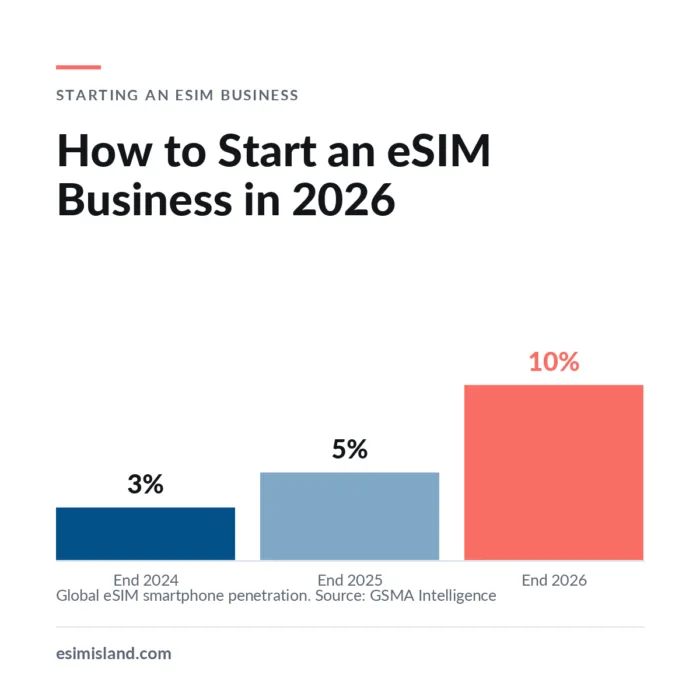
Global eSIM smartphone penetration, 2024 to 2026
Source: GSMA Intelligence consumer eSIM adoption data, reported 2025 and 2026. Penetration is expected to double again during 2027.
GSMA Intelligence put global eSIM smartphone penetration at roughly 5% at the end of 2025 and expects it to reach around 10% by the end of 2026, then double again during 2027. For context, penetration stood at approximately 3% in 2024, with nearly half of that concentrated in the United States. By 2030 the same research expects 4.9 billion eSIM smartphone connections, about 55% of all smartphone connections worldwide.
Penetration alone would not create a business opportunity. Plenty of technologies reach mass device support without generating a consumer market around them. What creates the opportunity here is the behaviour attached to that penetration, and specifically the fact that travel is overwhelmingly the entry point. GSMA research found that 51% of eSIM users first tried the technology for international travel. Once they have, they rarely return to hunting for a physical SIM at an airport kiosk.
Sources: Opensignal global user base measurement, Q2 2026; Kaleido Intelligence traveller survey, 2026; GSMA consumer research.
The most commercially interesting number in that set is the $28 average spend per trip, up 133% year on year. Travel eSIM began as a cheap alternative to operator roaming and is maturing into a category where customers buy larger allowances, longer validity and, in 15% of cases, unlimited plans. Average revenue per customer is rising rather than falling, which is unusual for a digital category three years into mass adoption and suggests the category is not going to compete itself to zero on price.
Average traveller spend per trip, 2026
Source: Kaleido Intelligence traveller survey, 2026. Travel eSIM spend per trip is rising while roaming spend falls, and 15% of travel eSIM buyers now choose unlimited plans.
The other half of that picture is where the money is coming from. Opensignal measured travel eSIM users rising from 1.7% to 3.3% of its global user base between the second quarter of 2025 and the same quarter of 2026, while operator roaming shed 5.2 percentage points of traveller share over the same period. This is not a category growing into empty space. It is taking revenue directly out of operator roaming, which is a large and well-established pool.
What an eSIM business actually sells
The phrase “start an eSIM business” covers four quite different businesses with different capital requirements, timelines, regulatory exposure and skill sets. Choosing the wrong one is the most expensive mistake available at this stage, because the decision determines your cost base and your speed for years afterwards.
| Model | What you actually sell | Capital needed | Realistic time to launch | Best suited to |
|---|---|---|---|---|
| Reseller / white label | Branded data plans through a ready-made storefront you control | Low | 2 to 6 weeks | First-time entrants, travel brands, marketers with an audience |
| API integration | eSIM issued inside your existing app, booking flow or checkout | Medium | 4 to 12 weeks | Online travel agencies, travel apps, fintechs, platforms with existing users |
| Business roaming | Managed connectivity for a company's staff, fleet or devices | Medium | 6 to 12 weeks | B2B service providers, IT resellers, corporate travel management firms |
| Full MVNO | Your own carrier agreements, core platform and numbering | High | 9 to 24 months | Funded telecom ventures with regulatory capacity |
Timelines reflect typical launch projects with an established wholesale partner and vary by market and integration depth.
The reseller and white-label model
You take wholesale data from a provider, package it under your own brand and pricing, and sell it through a storefront you control. The provider handles carrier relationships, profile generation, the provisioning platform and the underlying network quality. You handle brand, pricing, marketing, customer relationship and first-line support.
This is the right starting point for most entrants because it separates the two hard problems. Telecom infrastructure is genuinely difficult and someone else has already solved it. Distribution is also genuinely difficult and nobody can solve it for you. The reseller model lets you spend all your effort on the second problem.
The API integration model
Instead of building a destination for customers to visit, you issue eSIMs inside a flow they are already completing. A booking confirmation page offers a data plan for the destination just booked. A travel app surfaces connectivity when a trip is added. A fintech offers a plan alongside a multi-currency card.
This is the strongest position in the category if you already have the users, because it solves acquisition cost almost entirely. The customer is not searching for an eSIM provider and comparing five of them; they are being offered a relevant product at the moment of need by a brand they already trust. It requires development work and a provider with a genuinely usable API, but the economics are better than anything a standalone store can achieve.
The business roaming model
Rather than selling to travellers one trip at a time, you sell managed connectivity to organisations: staff who travel, vehicles, devices, field teams. The buyer is an IT manager, a travel manager or a procurement lead, and they are buying predictability and control rather than the lowest price per gigabyte.
Order values are larger, churn is much lower, and price sensitivity is a fraction of the consumer market. The trade-off is a longer sales cycle and a requirement for account management, reporting and centralised administration. Many resellers add this as a second product once the consumer side is running, and find it becomes the more profitable half of the business.
The full MVNO model
You negotiate your own carrier agreements, run your own core platform, hold numbering ranges and take on the regulatory obligations of an operator. This is a telecom company, not a connectivity brand, and it is a nine to twenty-four month project with significant capital requirements.
It is the right answer for a small number of well-funded ventures with a specific strategic reason to control the stack. For almost everyone reading this, it is a way to spend two years and a great deal of money arriving at a position a reseller agreement would have delivered in a month.
How to choose your first market
The instinct is to launch globally, because the product is digital and there is no logistical reason not to. This is almost always a mistake. A global launch means competing everywhere against providers who are established somewhere, with no depth advantage anywhere. A narrow launch means you can be genuinely better than the incumbents on one route, in one language, or for one type of traveller.
| Market type | Example | Competition | What wins here |
|---|---|---|---|
| Mature, high-penetration | United States, where eSIM-only iPhones have shipped since 2022 | Very high | Brand, distribution partnerships, or a vertical nobody else serves |
| Large but under-converted | United Kingdom, high awareness and high search demand, low conversion | High | Better landing pages and clearer pricing than the incumbents |
| Mid-curve | Gulf states, Southeast Asia, parts of Central and Eastern Europe | Moderate | Local language, local payment methods, local trust signals |
| Corridor-specific | A single origin-destination pair, such as UK to UAE or India to Gulf | Low | Depth on one route: pricing, coverage detail, community distribution |
| Vertical | Pilgrimage travel, expedition tourism, offshore crews, film production | Low | Understanding the operational need better than a generic provider |
Regional competition assessment based on published adoption forecasts from GSMA Intelligence and observed provider concentration.
The strongest early positions tend to be corridors and verticals rather than countries. A corridor is a specific origin-destination pair with real volume and shared characteristics: the same language, the same payment preferences, the same communities discussing travel in the same places. A vertical is a group of travellers with an operational need a generic provider does not understand, such as offshore crews rotating on fixed schedules, pilgrimage travel with sharp seasonal peaks, or production teams who need reliable upload bandwidth.
Both are defensible in a way that “global travel eSIM store” is not. They are also far cheaper to acquire customers in, because the audience is reachable through specific communities rather than through open auction advertising.
The seven-step launch roadmap
The order matters more than the individual steps. Most failed launches did roughly the right things in the wrong sequence, usually by building a brand and a website before understanding their wholesale cost base or their route to customers.
Choose a market before you choose a brand
Decide who you are selling to first: outbound travellers from one country, a diaspora corridor, business travellers in a sector you already serve, or an audience you already own through a travel site, app or agency. A narrow starting market gives you pricing power and a far cheaper first customer. Naming the company and buying a domain before this decision is the most common way founders lock themselves into a positioning that does not fit the market they end up serving.
Pick the model that matches your assets
If you already have traffic or customers, API integration puts eSIM inside a flow people are already completing, which is the cheapest possible acquisition. If you are starting from nothing, a white-label store gets you selling while you learn what converts. Do not start with an MVNO unless connectivity is your core business and you are funded for a multi-year regulatory project.
Select your wholesale partner and sign the NDA
This decision sets your margin ceiling for years. You are evaluating coverage in your target countries, the wholesale rate at your expected volume, network quality on the underlying carriers, the dashboard and API, and how support handles a customer whose eSIM will not activate at two in the morning in a foreign airport. Most providers begin with a mutual NDA, then issue a proposal priced around your specific destinations and volumes.
Set up the legal and payment layer
Register the entity, write terms of service and a refund policy that reflects the fact that eSIM profiles are consumed on activation, and get a payment gateway approved. Digital connectivity attracts extra scrutiny from processors because of chargeback history in the wider prepaid telecom category, so budget time for underwriting rather than assuming instant approval. Sort your tax position for cross-border digital sales at the same time.
Build the storefront and the activation experience
The buying flow matters less than the twenty minutes after purchase. Plan for clear QR delivery, a device compatibility check before payment rather than after, plain-language installation steps with screenshots for both iOS and Android, and a support path for the minority of customers whose install fails. This is where most of your refund risk lives.
Price your plans against the wholesale rate, not the competition
Start from your landed cost per gigabyte in each destination, add the margin your acquisition cost requires, then sanity-check the result against the market. Copying a competitor's retail price without knowing their wholesale rate is how new resellers end up selling at a loss on their highest-volume destination.
Launch into one channel and prove the numbers
Pick a single acquisition channel and run it until you know your true cost per sale, your refund rate and your repeat purchase rate. Add a second channel only once the first one works. Businesses that launch four channels at once cannot tell which one is carrying them and burn their budget learning nothing.
What it actually costs to start
The honest answer is that the software is the cheap part and customer acquisition is the expensive part. A white-label eSIM business can be technically operational for a few thousand dollars. Getting it to profitability is a marketing problem, and budgets should be weighted accordingly. Any cost breakdown that omits acquisition is describing a hobby rather than a business.
| Cost item | Indicative range | What drives it |
|---|---|---|
| Company formation, terms and privacy policy | $500 to $3,000 | Jurisdiction, and whether you use a lawyer or a template service |
| Domain, hosting and business email | $150 to $600 per year | Traffic volume and whether you need managed hosting |
| White-label storefront | $0 to $5,000 | Often included in a reseller program; custom builds cost more |
| Brand identity and design | $300 to $3,000 | Freelance versus agency |
| Payment processing | Roughly 2.9% plus a fixed fee per transaction | Standard card processing, higher for some regions and currencies |
| Initial commitment or deposit to your eSIM partner | $0 to $5,000 | Varies widely; many reseller programs have no minimum |
| Support tooling and helpdesk | $0 to $100 per month | Free tiers cover early volume comfortably |
| First 90 days of marketing | $1,500 to $15,000 | The single most variable line, and usually the largest |
Indicative planning ranges compiled from typical launch projects, not quoted prices. Request a proposal for figures specific to your markets and volumes.
Notice what is missing from that table. There is no line for network infrastructure, SIM manufacturing, inventory, shipping, customs or carrier integration. That absence is the entire commercial case for the reseller model. Those costs still exist; they are carried by your wholesale partner and recovered through the data rate you pay. What you are buying is the removal of both the capital requirement and the years of lead time.
The unit economics, worked through
An eSIM business makes money on the spread between the wholesale rate it pays for data in a given country and the retail price it charges for a packaged plan. Because the product is fully digital there is no cost of goods beyond that data, no shipping and no inventory write-off. Gross margins in the category are structurally healthy. Net margins are a different question entirely, and the difference between the two is where most new entrants get caught out.
The model below is illustrative. Every figure except the retail price is a placeholder, and the exercise is to replace them with your own. What matters is the shape of the result rather than the specific numbers.
| Line | Per order | Note |
|---|---|---|
| Retail price of a 5GB regional plan | $24.00 | Roughly in line with the $28 category average spend per trip |
| Wholesale data cost | ($8.40) | Illustrative 35% of retail; your real figure comes from your rate card |
| Payment processing | ($1.00) | About 2.9% plus a fixed fee |
| Gross profit | $14.60 | 61% gross margin before acquisition |
| Customer acquisition cost | ($11.00) | The variable that decides whether the business works |
| Support and refund allowance | ($1.20) | Assumes a small share of orders need help or a refund |
| Contribution per first order | $2.40 | Thin on order one, which is the point |
| Contribution per repeat order | $13.40 | No acquisition cost, so nearly all gross profit drops through |
Illustrative worked example, not a quotation or a performance claim. Retail price is anchored to the published category average; all other figures are placeholders for you to replace with your own rate card, processing terms and measured acquisition cost.
Two things stand out. The first is that a healthy 61% gross margin becomes a contribution of $2.40 once acquisition and support are counted. On a first order, in a business with realistic acquisition costs, the margin is thin. That is normal for the category and it is not a reason to avoid it.
The second is what happens on the repeat order, where there is no acquisition cost and contribution jumps to $13.40.
The practical implication is that your business plan should be built around repeat rate rather than first-order margin. Two levers matter most. The first is top-ups, because a customer topping up an installed profile faces no reinstallation friction and converts at a much higher rate than one buying a new plan. The second is the trigger, because travel is predictable and a well-timed reminder before a customer’s next trip costs almost nothing and converts far better than any paid channel.
It also means you should be sceptical of any plan that depends on paid search for the majority of volume. On a $24 average order value with an $11 acquisition cost, there is very little room for that cost to rise before the first order becomes loss-making, and paid auction costs rise as competition increases rather than falling.
Global travel eSIM retail spend
Source: Kaleido Intelligence travel eSIM research. By 2028 travel eSIM is forecast to account for over 80% of all travel SIM spend.
The wider market context supports the model. Kaleido Intelligence tracked travel eSIM retail spend at $3.3 billion in 2025 and expects it to approach $5 billion in 2026, on the way to close to $10 billion by 2028, at which point travel eSIM is forecast to account for over 80% of all travel SIM spend. A category growing at that rate with rising average order values gives a new entrant room to find a position.
Pricing and packaging your plans
Pricing is where most of the controllable margin lives, and it is usually decided carelessly. The common error is to open three competitor sites, take the middle price and launch. Since you do not know their wholesale rate, their volume commitments or whether that destination is a loss leader for them, this tells you nothing about whether the price works for you.
Start instead from your landed cost per gigabyte in each destination. Add the gross margin your acquisition cost requires, using the model above. Then check the result against the market, and if you are materially more expensive, ask what you can offer that justifies it. Often the answer is a better activation experience, clearer coverage information, support in the customer’s language, or a package shape nobody else offers.
| Packaging decision | Option A | Option B | What usually decides it |
|---|---|---|---|
| Allowance structure | Fixed data buckets, such as 1GB, 5GB, 10GB | Unlimited with a fair-use throttle | Unlimited converts better and is now chosen by 15% of buyers, but needs a wholesale deal that supports it |
| Validity | Short windows matched to trip length | Long windows, 30 days and above | Short windows raise margin; long windows reduce support load and refunds |
| Geography | Single country | Regional or global bundles | Multi-country plans carry premium pricing and are harder for competitors to match |
| Top-ups | Customer buys a new plan | Customer tops up the installed profile | Top-ups lift repeat revenue sharply because there is no reinstall friction |
| Number of SKUs | Three or four per destination | A dozen or more | Fewer options convert better; long lists create decision paralysis |
Two packaging decisions deserve particular attention. Multi-country bundles carry premium pricing and are harder for competitors to match precisely, which makes them a good place to build margin, and they suit the long-haul and multi-country travellers who are 2.5 and 1.5 times more likely respectively to use a travel eSIM at all. And the number of options should be small. A destination page offering three well-chosen plans converts better than one offering fourteen, because the customer is standing in an airport with limited patience.
Legal, tax and compliance before launch
This is the section most guides skip, and it is the one that causes the most avoidable trouble later. Selling a digital service that is consumed in a different country from where you are incorporated touches several regimes at once, and the obligations arrive earlier than most founders expect.
| Area | What to check | Why it matters |
|---|---|---|
| Telecom licensing | Whether resale of connectivity provided by a licensed operator requires registration in each market you sell into | Reselling usually does not require your own licence, but a few markets regulate resale directly |
| Customer identity verification | Whether the destination country mandates SIM registration or identity checks at point of sale | Several markets require KYC for any connectivity sold for use there, which changes your checkout |
| Consumption tax | VAT, GST or sales tax treatment of a digital service sold cross-border | Digital services rules often tax at the customer's location, with registration thresholds that arrive quickly |
| Data protection | What personal data you collect, where it is processed, and your lawful basis | Selling into the EU or UK brings GDPR obligations regardless of where you are incorporated |
| Consumer rights and refunds | Statutory cancellation rights for digital goods and how activation affects them | An unclear refund policy on a consumable digital product produces disputes and chargebacks |
| Advertising claims | Coverage, speed and unlimited claims | Overstated coverage is the most frequent source of complaints in the category |
General planning guidance, not legal or tax advice. Requirements vary by jurisdiction and change frequently. Take professional advice for the specific markets you intend to sell into.
The general position on licensing is that reselling connectivity supplied by a licensed operator does not require you to hold a telecom licence yourself, because the licensed party in the chain is your wholesale partner. This holds in most markets but not all, and a small number of countries regulate the resale of connectivity directly or require local registration. Confirm the position for the markets you intend to sell into rather than assuming.
Consumption tax deserves early attention because digital services rules in many jurisdictions tax at the customer’s location rather than yours, and registration thresholds can be low or absent. The refund policy also deserves real thought: an eSIM profile is consumed on activation, so a policy written for physical goods will not survive contact with a customer who activated a plan, used two gigabytes and then asked for a full refund.
None of this is a reason not to proceed. It is a reason to spend a few hundred dollars on proper advice for your specific markets before launch rather than after your first dispute.
Designing the activation experience
The buying flow gets most of the attention and the twenty minutes after purchase decide whether the business works. A customer who cannot install their profile is a refund, a support ticket and a negative review, and they are having that experience while standing in an unfamiliar airport with no connectivity, which is the worst possible moment for a poor experience.
Where installs fail
- The device does not support eSIM, or supports it but is carrier-locked
- The QR code has already been redeemed on another device
- Installation attempted without an internet connection, which the profile download requires
- The customer installs correctly but leaves their home line as the data line
- Data roaming left switched off on the new profile
- The plan was activated days before the trip and the validity window has expired
What prevents them
- A compatibility check before payment, not in a footer FAQ
- Separate installation instructions for iOS and Android, with screenshots
- Plain wording on when the validity window starts
- A pre-departure reminder email with the QR code attached again
- Profile diagnostics in your dashboard so support can see the actual state
- The ability to reissue a profile without a manual escalation
The single highest-return fix is moving the device compatibility check before payment. Selling a plan to someone whose phone cannot use it guarantees a bad outcome, and a check at the point of purchase costs nothing and eliminates an entire class of failure. The second highest is clarity about when the validity window starts, because customers who install a week early and find the plan expired on arrival are correctly annoyed and will say so publicly.
How to choose your eSIM provider
Because your wholesale agreement determines your margin ceiling, provider selection deserves considerably more diligence than most new entrants give it. The questions below separate providers who can support a real business from those reselling someone else’s inventory with a markup and no operational depth behind it.
Ask every provider this
- Which carriers do you use in my top five destinations, and is that contractual?
- What is the wholesale rate per gigabyte in those destinations at my expected volume?
- Can I create my own packages, or only resell yours?
- Do I get real-time usage data through an API and webhooks?
- What is your activation success rate, and how is it measured?
- Who supports the end customer at two in the morning, me or you?
- Do I keep the customer relationship and the data if I leave?
- Can I test in a sandbox before committing?
Treat these as warning signs
- Pricing quoted only as a retail discount, with no visibility of the underlying rate
- No named carriers, only a country count
- Long lock-in with a large upfront commitment before you have sold anything
- No sandbox or test credentials before you sign
- Support that runs in one time zone when your customers travel across all of them
- An inability to issue multi-country packages
- Vague answers about who owns the end-customer data
One question deserves special weight: whether you can build your own packages. A provider who only lets you resell their fixed plans has capped your ability to differentiate on product, which leaves you competing on price against everyone else reselling the same plans. A provider who lets you define your own allowances, validity periods, country combinations and top-up rules gives you room to design an offer that fits your specific market.
The second is who owns the end-customer relationship and data. If leaving your provider means losing your customers, you do not have a business, you have a temporary arrangement.
Getting your first thousand customers
Every channel in the category works for someone and none of them work for everyone. What matters is matching the channel to what you actually have, rather than starting with whichever one is easiest to begin.
| Channel | How it behaves | Speed to first sale | Honest assessment |
|---|---|---|---|
| Destination SEO | Content for specific destinations and corridors | Slow, 3 to 9 months | The best long-term economics in the category, and the most crowded at the generic end. Wins on specificity. |
| Paid search | Bidding on high-intent travel eSIM terms | Immediate | Fast but expensive. You are bidding against funded incumbents on a low average order value. |
| Affiliate and creator partnerships | Travel bloggers, YouTubers, community admins | Weeks | Strong fit because the recommendation carries trust. Requires real margin to fund the commission. |
| Embedded distribution | eSIM offered inside a booking flow, app or agency checkout | Months to set up | The highest-converting channel available, because it reaches the customer at the moment of need. |
| B2B and corporate accounts | Selling managed connectivity to companies | Long sales cycle | Larger order values, far lower churn, and much less price sensitivity than consumer. |
| Your existing audience | Customers or traffic you already have | Immediate | The cheapest customers you will ever acquire. If you have this, start here. |
If you already have an audience, customers or traffic, start there and ignore everything else until you have exhausted it. Those customers cost nothing to reach, they convert at rates paid channels cannot approach, and they will tell you what is wrong with your product before you spend money advertising it.
If you do not, the realistic sequence for most new entrants is a narrow content position on a corridor or vertical, supported by partnerships with people who already have that audience’s attention. Paid search has its place for testing messages and validating demand quickly, but building a business on it at this average order value is difficult and gets harder as the category matures.
Running support without it running you
Support in this business is unusual in two ways. The volume is concentrated in the first hour after purchase, and the customer is almost always in a foreign country and often without connectivity, which means email-only support fails precisely when it is needed.
The practical answer for a small operation is to remove the causes rather than staff for the volume. Compatibility checks before payment, clear dual-platform instructions, a reminder before departure, and dashboard diagnostics that let you see a profile’s actual state without escalating to your provider will together eliminate most tickets. What remains should be reachable through a channel that works on a hotel wifi connection, which in practice means a messaging channel rather than a phone line.
Track two numbers from the first week: activation success rate and refund rate. Both are early warning systems. A rising refund rate almost always traces back to a specific destination, device type or plan, and finding that pattern early is much cheaper than discovering it in a batch of reviews.
Five mistakes that kill new eSIM businesses
Launching without a distribution plan. The technology is now the easy part, which means everyone can build a store. The businesses that survive have an audience, a partner channel or a specific corridor they can win. “We will run Google Ads” is not a distribution plan when you are bidding against funded incumbents on a low average order value.
Pricing off competitors instead of costs. Your competitor may have a wholesale rate half of yours in a given country, or may be running that destination as a loss leader. Matching their retail price there can mean selling at a loss on your highest-volume route without realising it for months.
Underestimating support. A meaningful share of first-time eSIM buyers need help installing. Support quality is a conversion and refund issue, not a cost centre to be minimised at launch.
Ignoring device compatibility before checkout. Selling an eSIM to someone whose phone cannot use one produces a refund, a bad review and a support ticket, all of which were preventable with a check that costs nothing.
Treating it as passive income. The margins are good and the operations are light, but this is a real business with real customers who are stranded abroad when something breaks. It rewards operators, not spectators.
A realistic 90-day launch timeline
This assumes a white-label launch with an established provider and one person driving it. An API integration adds four to eight weeks depending on depth.
| Period | Focus | What should be finished |
|---|---|---|
| Days 1 to 14 | Decisions | Target market chosen, model chosen, provider shortlist contacted, NDAs signed, proposals requested |
| Days 15 to 30 | Foundations | Provider selected, entity registered, payment gateway application submitted, brand and domain settled |
| Days 31 to 45 | Build | Storefront configured, packages and pricing built from the rate card, activation emails and instructions written |
| Days 46 to 60 | Test | End-to-end test purchases on iOS and Android, compatibility check live, support process documented, refund policy published |
| Days 61 to 75 | Soft launch | Selling to a small audience, measuring activation success and refund rate, fixing what breaks |
| Days 76 to 90 | Scale one channel | Single acquisition channel running with measured cost per sale, repeat rate baseline established |
The most commonly underestimated item is payment gateway approval, which sits in the middle of the timeline and can stall everything behind it. Start that application as early as your entity registration allows.
Frequently asked questions
Start your eSIM business with a partner who handles the infrastructure
eSIM Island provides wholesale data rates, a white-label store, the Connect+ dashboard and API access so you can launch a branded eSIM business without building telecom infrastructure. Tell us your target markets and expected volumes and we will prepare a pricing proposal.
Book a Free DemoOr explore the Reseller Program, API Integration and Business Roaming.
Leave a Reply