
Most eSIM reseller guides skip the part that actually determines whether the business works. You can build a storefront in a weekend and write good marketing copy in an afternoon, but your margin ceiling was set the day you signed a wholesale agreement, and it was set by mechanics most resellers never see.
This is an explanation of how wholesale roaming works commercially and technically, why rates vary so much between countries that look similar, what you can and cannot control as a reseller, and the specific questions that protect your margin before you sign anything.
What you actually control
- Your margin is set by a wholesale rate you negotiate, not by the retail price you advertise.
- Rates differ enormously by country because the underlying agreements do. There is no global price for a gigabyte.
- Coverage claims are only as good as the named carriers behind them. "200+ countries" tells you nothing.
- Network selection and steering are handled upstream, but they decide whether your customer is happy.
- The questions that protect your margin are asked before you sign, not after.
What you are actually buying
When a customer of yours lands in Spain and their phone connects, they are using a Spanish operator’s radio network. That access was arranged through a chain of agreements, and each link in that chain takes a margin. Understanding the chain explains almost every pricing oddity you will encounter.
| Layer | Who they are | What they contribute | What they take |
|---|---|---|---|
| Host network | The mobile operator in the destination country | The actual radio network your customer connects to | A wholesale rate per gigabyte, set by agreement |
| Sponsor operator or hub | An operator or roaming hub with agreements in many markets | Aggregated access without you signing hundreds of contracts | A margin on the wholesale rate |
| eSIM platform / aggregator | Your wholesale partner | Profile generation, provisioning, dashboard, API, support | A margin, plus platform value |
| You, the reseller | The brand the customer buys from | Packaging, pricing, marketing, first-line support | The retail spread |
Simplified view. Some partners sit at more than one layer, which is usually why their rates in particular countries are better than others.
The practical consequence is that your rate in any given country reflects how many layers sit between you and the host network there. A partner with a direct agreement in a market will usually beat one buying through a hub, and will also be able to resolve problems there rather than passing them along.
This is also why no partner is best everywhere. Providers have deep positions in some regions and thin ones elsewhere, which is why the honest answer to “who has the best rates?” is always “in which countries?”
Why rates differ so much between countries
New resellers are often surprised that two neighbouring countries with similar economies can have wholesale rates that differ by a large multiple. The reasons are structural rather than arbitrary.
| Why rates differ | What it means for you |
|---|---|
| Agreement depth - whether your partner has a direct deal with the host network or buys through another layer | Direct agreements usually mean better rates and better troubleshooting in that market |
| Traffic balance - operators trade access, so markets they send traffic to get better terms | Rates can be excellent in one country and poor in a neighbouring one for no customer-facing reason |
| Volume commitments - committed volume buys lower rates | Your rate improves as you grow, which is why the first rate card is not the final one |
| Local market structure - competitive markets with many operators price lower | Popular destinations are not automatically cheap; some high-demand markets stay expensive |
| Regulatory caps - some regions cap wholesale roaming charges | Margins can be thinner where retail prices are already low because of regulation |
Traffic balance deserves a note, because it explains most of the anomalies. Operators historically settled roaming by trading access, so a network that sends a lot of subscribers into another country negotiates better terms for receiving that country’s subscribers. Those legacy positions still shape wholesale pricing, and they have nothing to do with how attractive a destination is to your customers.
The implication for your business is direct: build your destination pricing from your own rate card rather than from what competitors charge. A competitor with a better position in Thailand can price aggressively there while you would be selling at a loss matching them.
Where the margin comes from
The commercial opportunity in travel eSIM exists because operator retail roaming has long been priced far above the wholesale cost of the same data.
Average traveller spend per trip, 2026
Source: Kaleido Intelligence traveller survey, 2026. Retail roaming pricing sits far above the wholesale cost of the same data, which is where reseller margin comes from.
Sources: Opensignal global user base measurement, Q2 2026; Kaleido Intelligence.
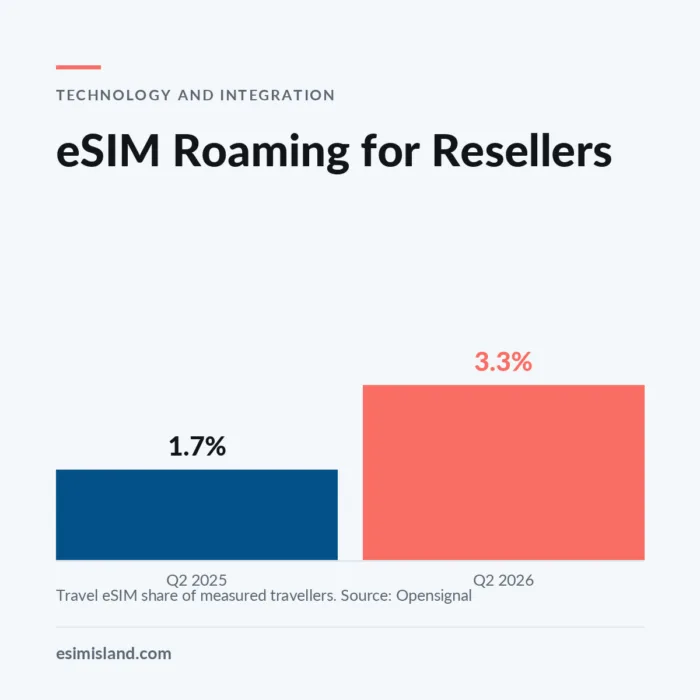
Opensignal measured travel eSIM rising from 1.7% to 3.3% of travellers between Q2 2025 and Q2 2026, while operator roaming lost 5.2 percentage points of share over the same period. That is a direct substitution, and it is being driven by exactly the price gap shown above.
How to read a wholesale rate card
Rate cards are not standardised, and two quotes that look comparable can behave very differently once traffic is running. These are the specifics that change your actual cost.
How to read a rate card
- Is the rate per gigabyte, per megabyte or per package?
- Is it charged on data used or data allocated?
- What is the rounding increment, and does it round per session?
- Which carriers does each country rate cover?
- Does the rate change above or below certain volumes?
- Are there platform, profile or activation fees on top?
- How long is the rate held before review?
Warning signs
- A single global rate quoted for every country
- Pricing given only as a discount off retail
- Coverage stated as a country count with no carriers named
- Charges on allocated rather than used data, unstated
- No sandbox or test profiles before you commit
- Large upfront commitment before you have sold anything
The distinction between data used and data allocated matters more than any headline rate. If you are charged for the full allowance whether the customer consumes it or not, a 5GB plan where the average customer uses 2GB has a very different cost profile than the rate card suggests. Ask this explicitly and get the answer in writing.
Rounding is the second quiet cost. Per-session rounding to a large increment can add meaningfully to a bill made up of many short sessions, which is exactly the usage pattern of a traveller checking maps and messages throughout a day.
Network quality, and how to check it
Coverage and quality are different things. A profile can attach in a country and still deliver an experience that generates refunds. Since you cannot inspect the underlying agreements, you have to test.
Get the carrier list, not the country count
Ask which named host networks your profiles will use in your top five destinations, and whether that is contractual or best-effort. "Coverage in 200 countries" is a marketing statement. "Vodafone and Orange in Spain, contractually" is information you can act on.
Test on the ground before you launch
Get test profiles and have someone use them in your main destinations, or ask contacts to. You are checking whether the profile attaches quickly, which network it lands on, whether it holds through a border crossing, and what happens when the allowance runs out.
Ask how steering works
When several networks are available, something decides which one your customer attaches to. Ask whether selection prioritises cost or quality, whether it can fall back if the preferred network is congested, and whether you have any visibility of it.
Check the throttle and expiry behaviour
Find out exactly what happens when a customer exhausts their allowance or reaches the end of validity. Silent disconnection abroad generates far more support volume than a throttled connection with a top-up prompt.
Confirm diagnostics and reissue rights
You need to see a profile's actual state in a dashboard, and you need to reissue a profile without escalating to your partner. Without both, every activation problem becomes a support ticket you cannot resolve yourself.
Re-test after any rate change
Rate improvements sometimes come with a change in the underlying carrier mix. If your cost in a country drops sharply, check that quality has not dropped with it before your customers tell you.
Steering is the mechanism worth understanding even though you do not control it. When multiple host networks are available, selection logic decides where your customer attaches. Logic that optimises purely for cost can put customers on a congested or poorly covered network in a market where a better option existed. This is invisible on a rate card and very visible in your reviews.
Designing plans around the rates you actually have
Once you understand your rate card, plan design becomes an exercise in matching packages to where your economics are strongest rather than copying what everyone else sells.
Three moves usually follow. Build regional bundles around countries where your rates are competitive, so the blended cost works even if one country in the bundle is expensive. Price single-country plans in your strong markets aggressively, since that is where you can win on price without losing money. And treat top-ups as a distinct product, because a customer topping up an installed profile costs you nothing to acquire and faces none of the installation friction of a new purchase.
Frequently asked questions
See wholesale rates for your actual destinations
Rates vary too much by country for a generic quote to be useful. Tell eSIM Island your top markets and expected volumes and we will prepare a rate card you can build real pricing against, along with the carrier detail behind it.
Book a Free DemoOr explore the Reseller Program, API Integration and Business Roaming.
Leave a Reply