
The case for starting an eSIM business is genuinely strong, which is why it is made so often and usually so uncritically. Low startup costs, no inventory, digital delivery and a market growing quickly are all real advantages, and they are the reason this category has attracted so many entrants in the last two years.
This is that case set out properly, with the counterweight attached to each point. The benefits are real. They are also available to everyone else entering the category, which is the part most articles leave out and the part that determines whether you end up with a business or an expensive hobby.
The benefits, and the honest counterweight
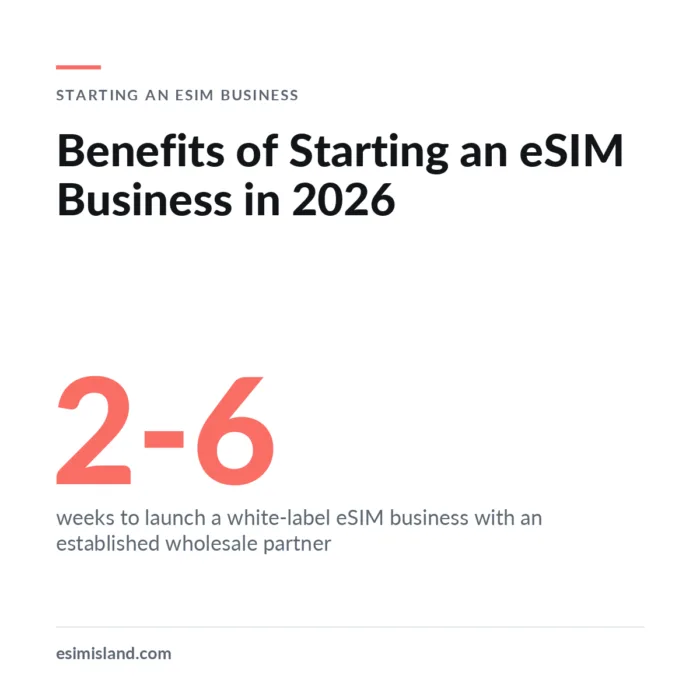
- Low startup cost, no inventory and a launch measured in weeks rather than years.
- Strong gross margins, because a digital product has no cost of goods beyond the data.
- A genuinely global addressable market from day one.
- But: net margin is decided by customer acquisition cost, not by gross margin.
- And: an unknown brand faces a real trust disadvantage that has to be solved somehow.
Why the timing is favourable
The underlying demand is not speculative. Two events in late 2025 removed the structural blockers: Apple extended its eSIM-only iPhone design into global markets, and Chinese operators launched smartphone eSIM services for the first time.
Global eSIM smartphone penetration
Source: GSMA Intelligence. Penetration is expected to double again during 2027.
Sources: Kaleido Intelligence, 2026; GSMA consumer research.
GSMA Intelligence put global eSIM smartphone penetration at roughly 5% at the end of 2025, forecast to reach around 10% by the end of 2026 and double again during 2027. Kaleido Intelligence expects travel eSIM retail spend to approach $5 billion in 2026. And GSMA research found 51% of eSIM users first tried the technology while travelling abroad, which is why travel is where the commercial activity is concentrated.
The benefits, each with its caveat
Every row below is genuinely an advantage of this business model. Every row also has a qualifier that decides whether the advantage translates into profit.
| The benefit | Why it is real | The caveat nobody mentions |
|---|---|---|
| Low startup cost | No infrastructure, no inventory, no carrier negotiations | The software is cheap; customer acquisition is not |
| Fast launch | 2 to 6 weeks with an established wholesale partner | Operational in weeks is not the same as profitable in weeks |
| Strong gross margins | Digital delivery, no shipping, no write-offs | Everyone in the category has good gross margins; it differentiates nobody |
| Global reach | No physical presence required in any market | Selling everywhere usually means being strong nowhere |
| Scalable | 10 or 10,000 customers use the same infrastructure | Support does not scale automatically, and it peaks at first install |
| Repeat revenue | Travellers buy again, and top-ups carry no acquisition cost | Only if you actively retain them; many buy once and vanish |
| Fits existing businesses | Travel brands can add it to what they already sell | This is the strongest case, and it does not apply to everyone |
| Growing demand | Adoption doubling year on year from a low base | A growing category attracts competitors as fast as customers |
The pattern across the table is that the benefits are structural to the category rather than specific to you. Low startup costs and strong gross margins apply equally to every competitor, which means they lower the barrier to entry for everyone. That is worth understanding clearly: the same characteristics that make this business easy to start make it crowded at the undifferentiated end.
The benefit that does differentiate
One row in that table behaves differently from the rest. “Fits existing businesses” is not available to everyone, and it is where the real advantage sits.
If you already reach travellers, whether through a booking flow, an app, a community or a corporate relationship, you can offer connectivity at close to zero acquisition cost to people who already trust you. Everyone else has to buy that attention at auction, against funded incumbents, on an average order value of around $28. That single difference explains most of the variation in outcomes in this category.
Who this business suits
Who benefits most
- Travel agencies, tour operators and booking platforms
- Apps and fintechs with international users
- Communities and creators serving a specific travel route
- IT resellers and MSPs selling to corporate accounts
- Anyone who already reaches travellers at the moment of need
Who benefits least
- Anyone building a generic global store with no audience
- Those expecting income without operational involvement
- Businesses planning to compete purely on price
- Anyone unable to fund a few months of acquisition testing
- Operators unwilling to support customers mid-trip
Being on the right-hand list is not a reason to abandon the idea. It is a reason to solve distribution before launching rather than after. Build the audience, secure the partnership or find the corridor first, and the benefits at the top of this page start applying to you rather than to your competitors.
Turning the benefits into a business
Identify the audience you already have
The benefits above are worth most to businesses that can reach travellers without buying attention. Before anything else, write down who you already reach and whether any of them travel internationally.
Pick a narrow first market
One corridor, one language, one traveller type. A narrow start makes your first customer cheap and gives you something to be genuinely better at than a global competitor.
Get wholesale rates before modelling anything
Sign an NDA and request pricing for your specific destinations at realistic volumes. Every margin projection made before you have a rate card is guesswork.
Model contribution, not gross margin
Subtract acquisition, payment processing and a support and refund allowance from your retail price. This is the number that tells you whether the benefits translate into a business.
Launch and measure three things
Cost per sale, activation success rate and repeat purchase rate. Ninety days of these tells you more than any amount of planning.
Build retention before you scale acquisition
Repeat purchases and top-ups carry no acquisition cost, which is where the margin actually lives. Getting this right first makes every subsequent marketing dollar work harder.
Step four is where most business plans in this category fail. Gross margin looks excellent on a spreadsheet and says nothing about viability. Contribution after acquisition, processing and support is the number that decides whether you are building something, and it is worth calculating before you name the company.
Frequently asked questions
See whether the benefits apply to your situation
The advantages of this model depend heavily on what you already have. Tell eSIM Island about your audience, your target markets and expected volumes, and we will give you wholesale pricing and an honest view of how the numbers look for you.
Book a Free DemoOr explore the Reseller Program, API Integration and Business Roaming.
Leave a Reply