
The UK is one of the more attractive markets in Europe for a travel eSIM business, for a reason that has nothing to do with technology. Most EU markets are difficult because roam-like-at-home removes the saving on intra-regional travel, which is where the volume is. The UK no longer has that protection.
This is a practical view of the UK market: what makes it structurally different, which corridors are worth targeting, what works and what does not, and where the regulatory position sits.
Why the UK is a distinctive market
- Post-Brexit, UK travellers no longer benefit from EU roam-like-at-home, and several operators reintroduced charges.
- That restores the saving on Europe trips, which is the highest-volume corridor for UK travellers.
- Adoption sits behind North America, so awareness is still forming while devices are ready.
- Competition is heavy in generic search and much lighter in corridors and communities.
- Reselling generally does not require an Ofcom licence, but confirm your position rather than assume.
What makes the UK different
| Factor | UK position | What it means for a reseller |
|---|---|---|
| Roaming baseline | EU roam-like-at-home no longer applies; several operators charge again for Europe | The saving exists on the highest-volume corridor, unlike most EU markets |
| Device eligibility | Strong; eSIM support widespread across recent handsets | Hardware is not the constraint |
| Adoption stage | Behind North America; Europe forecast past 50% around 2029 | Awareness marketing still matters as much as price |
| Outbound travel | High volume, with strong Europe, long-haul and diaspora corridors | Plenty of definable corridors rather than one undifferentiated market |
| Competition | Heavy in generic search; far lighter in specific communities | Corridor and community positioning beats broad targeting |
| Regulation | Ofcom operates a general authorisation regime rather than individual licences | Usually straightforward for resellers; verify your own obligations |
Operator roaming policies vary and change. Check current terms for the specific networks your target customers use.
The practical consequence is that a UK traveller taking a week in Spain or Italy is now a genuine prospect, which is not reliably true of a German or French traveller making the same trip. That single difference makes the highest-volume corridor in UK outbound travel commercially viable rather than marginal.
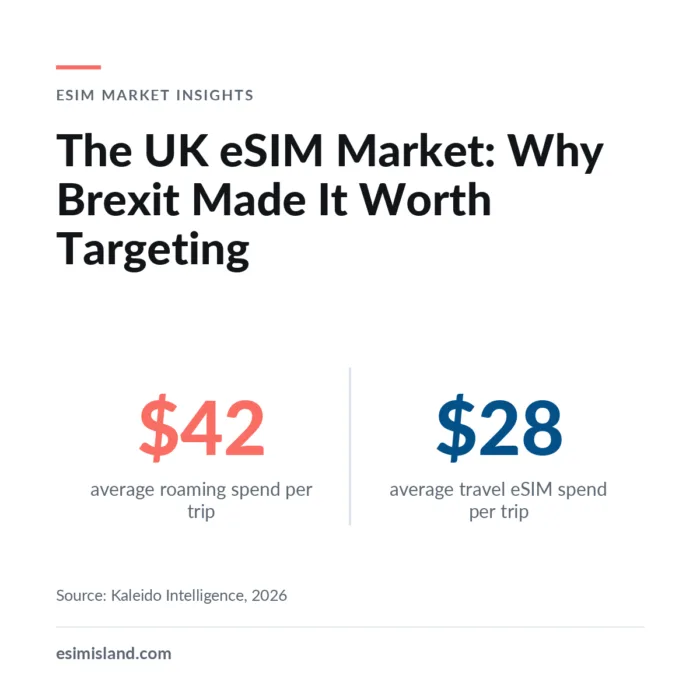
Average traveller spend per trip, 2026
Source: Kaleido Intelligence, 2026. Global averages. The gap is wider than this for UK travellers to Europe, where several operators reintroduced roaming charges after Brexit.
Sources: GSMA Intelligence; GSMA consumer research.
Where adoption sits
GSMA Intelligence expects Europe to pass 50% eSIM smartphone adoption around 2029, roughly two years behind North America. Global penetration is forecast to reach around 10% by the end of 2026, doubling again during 2027.
For a UK business the reading is favourable rather than discouraging. Devices are ready, so hardware is not the constraint, but awareness is still forming. That means marketing has to explain the product rather than only compete on price, and it means the market is not yet decided.
Corridors worth targeting
| Corridor | Why it works | How to reach it |
|---|---|---|
| UK to Europe | Highest volume, and roaming charges have returned for many | Short-break and city-break content; comparison against operator day passes |
| UK to long-haul leisure | Long-haul travellers are 2.5x more likely to buy | Destination guides; partnerships with tour operators |
| Diaspora corridors | Frequent, repeat travel to specific countries; strong community channels | Community groups, local media, language-specific content |
| Business travel | Repeat travellers, lower price sensitivity, managed spend | Sell to the company, not the traveller |
| Students and gap travel | Long stays, multi-country, price-sensitive but high repeat | University channels, long-validity and regional plans |
| Inbound to the UK | Visitors needing UK data; a different product entirely | Requires strong UK network rates; check before promising |
The diaspora row is the one most often overlooked and frequently the strongest starting position. These are travellers who make the same trip repeatedly, often several times a year, who share a language and who gather in identifiable community channels. Reaching them costs a fraction of what generic travel advertising costs, and repeat purchase rates are far higher than for one-off holidaymakers.
Inbound is a different business and worth separating. Selling UK data to visitors depends entirely on having competitive rates on UK networks, which is a question for your wholesale partner rather than an assumption to make.
What works here
What works in the UK market
- Comparing honestly against operator roaming day passes
- Corridor content rather than global positioning
- Clear pricing in pounds, with UK payment methods
- Plain statements about what happens on arrival
- Partnerships with travel businesses that already have the audience
What does not
- Competing on generic search against funded global brands
- Assuming travellers know what an eSIM is
- Ignoring that some operators still include Europe roaming
- Pricing in dollars for a UK audience
- Claiming savings without naming what you are comparing against
The comparison point matters more in the UK than almost anywhere, because the roaming picture is genuinely mixed. Some travellers pay per day for Europe, some do not, and a claim that ignores that difference will be wrong for a large share of your readers. Naming the specific tariff you are cheaper than, and the date you checked, converts a marketing claim into a verifiable one.
How to enter
Check the roaming baseline for your target customers
UK operator policies on European roaming differ, and some tariffs still include it. Your saving argument only holds against the operators and plans your actual audience uses, so establish that before building pricing or messaging around it.
Pick one corridor, not the country
"UK outbound travellers" is tens of millions of people with nothing in common. A specific origin-destination pair, a diaspora community or a traveller type gives you an audience you can actually reach at sensible cost.
Get rates for those destinations
Wholesale rates vary substantially by country for structural reasons. A corridor that looks attractive commercially can be unprofitable if your partner has a weak position in that destination.
Price in pounds and take UK payment methods
Conversion is decided by familiarity as much as price. Dollar pricing on a UK-targeted page introduces doubt at exactly the wrong moment.
Compare against something specific
"Cheaper than roaming" is unverifiable and reads as marketing. Naming the operator day pass you are cheaper than, with the date you checked, is both more persuasive and more defensible.
Confirm your regulatory position in writing
Reselling a licensed operator\'s connectivity generally does not require an individual licence in the UK, but obligations depend on what exactly you are providing. Get this checked rather than inferring it from an article.
Step six is worth doing properly rather than relying on general guidance, including this article. The UK operates a general authorisation approach rather than individual licences for most communications provision, and reselling a licensed operator’s connectivity is usually straightforward, but your obligations depend on what precisely you are providing and to whom. It is a short conversation with someone qualified and considerably cheaper than getting it wrong.
Frequently asked questions
Get rates for the corridors you are targeting
eSIM Island supplies UK-based resellers with wholesale rates, white-label stores and API access. Tell us which corridors you plan to serve and we will send per-country pricing and the carrier detail behind it.
Book a Free DemoOr explore the Reseller Program, API Integration and Business Roaming.
Leave a Reply