
Southeast Asia is discussed as a growth market for eSIM, and it is, but most analysis misses the structural point. The region is overwhelmingly a destination rather than an origin, which means the commercial opportunity is mostly about travellers arriving rather than residents departing.
That distinction changes everything: who your customer is, which market you advertise in, and, most importantly, what you are competing against. This is the region viewed properly, including an honest account of why the usual pricing argument does not work here.
The thing most analyses get wrong
- Southeast Asia is primarily a destination, not an origin. Most of the opportunity is inbound travellers.
- Your competitor there is not roaming. It is a cheap local SIM sold at the airport.
- That changes the argument entirely: convenience and arrival experience, not price.
- Device eligibility is more uneven than global averages suggest, because mid-range handsets dominate.
- Multi-country itineraries are the strongest product fit in the region.
Two different businesses
| Inbound travellers to the region | Outbound travellers from the region | |
|---|---|---|
| Who they are | Visitors from Europe, North America, Australia, East Asia | Residents, migrant workers, regional business travellers |
| Volume | Very high; the region is a major destination | Growing, concentrated in specific corridors |
| Device eligibility | High; they carry handsets from higher-eligibility markets | More variable; mid-range devices are common |
| Main alternative | A local prepaid SIM bought on arrival | Roaming, or a local SIM at destination |
| What wins | Working on landing, no queue, no passport, no cash | Price and repeat value on defined corridors |
| Where you sell | Before departure, in the origin market | Community and employer channels |
Both are real businesses. They require different products, different channels and different rate cards.
The row that matters most is the last one. If your customer is a visitor from Europe or Australia, you are not marketing in Thailand or Vietnam at all. You are marketing in the origin country, before departure, through destination content and partnerships with the businesses those travellers are already booking with.
Sources: Kaleido Intelligence, 2026; GSMA consumer research.
What you are actually competing against
This is the part that catches out businesses applying a European playbook to the region.
| Local SIM at the airport | Travel eSIM | |
|---|---|---|
| Price | Often very cheap | Usually higher |
| When it works | After queueing, registering and installing | The moment the plane lands |
| Registration | Passport required in several markets | Handled before travel |
| Your home number | Removed while the local SIM is in | Kept; the eSIM carries data only |
| Multi-country trips | A new SIM at each border | One profile across the region |
| Arrival experience | Finding a kiosk, cash, and a tray tool | Nothing to do |
The honest comparison: local SIMs usually win on price, travel eSIM wins on everything around it. Pricing strategy has to reflect that.
The honest position is that a local prepaid SIM will often be cheaper, sometimes dramatically so. Pretending otherwise fails immediately, because travellers to these destinations compare notes and the information is widely available.
What a local SIM cannot do is work the moment the plane lands, preserve the traveller’s own number for calls and messages, cover several countries on one profile, or remove the arrival ritual of finding a kiosk, producing a passport and handing over cash. Those are real advantages worth a premium, and they are the argument.
Device eligibility is more uneven here
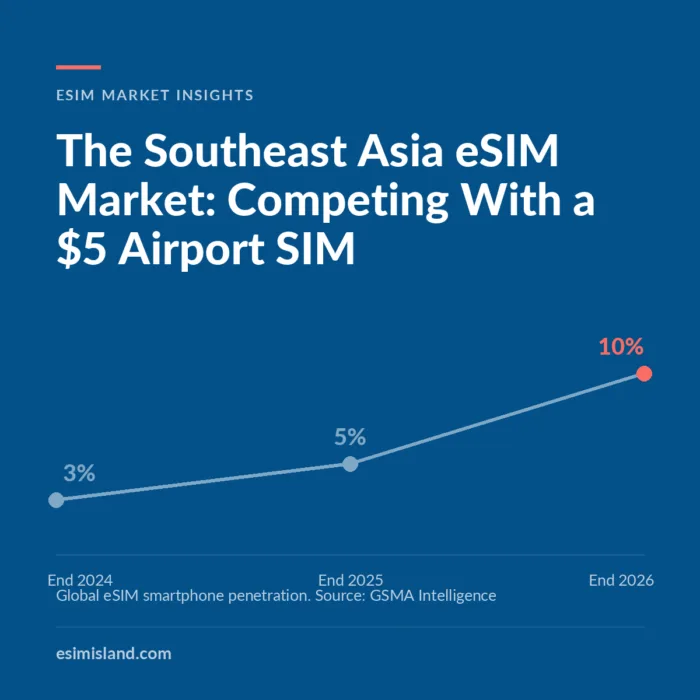
Global eSIM smartphone penetration
Source: GSMA Intelligence. Global figures. Device eligibility in Southeast Asia varies more than the average, because mid-range and budget handsets are more common.
Global penetration figures are forecast to reach around 10% by the end of 2026, but that average conceals wide regional variation. eSIM support concentrates in flagship and recent upper mid-range devices, so markets where budget handsets hold a larger share sit below the global picture. For inbound-focused businesses this barely matters, since visitors arrive with devices bought in higher-eligibility markets. For anyone selling to residents, it needs checking.
What works in this region
What works here
- Regional multi-country plans for island and border-hopping itineraries
- Selling in the origin market before departure
- Competing on arrival experience rather than price per gigabyte
- Partnerships with tour operators and booking platforms
- Being honest that a local SIM may be cheaper
What does not
- Trying to undercut a $5 airport SIM
- Selling to arrivals who already solved it in the terminal
- Assuming device eligibility matches global averages
- Single-country plans for multi-country trips
- Ignoring identity registration rules in some markets
Regional plans are the strongest product here and the clearest differentiator. A traveller doing Thailand, Cambodia and Vietnam in three weeks would otherwise buy three local SIMs, register three times and change numbers twice. One profile covering the whole trip is genuinely better rather than marginally more convenient, and multi-country travellers are around 1.5 times more likely to buy in the first place.
How to approach it
Decide whether you are selling inbound or outbound
These are two different businesses with different customers, channels and rate requirements. Most of the volume is inbound, and most of the competition for outbound sits in specific migrant corridors. Pick one to start.
If inbound, sell in the origin market
Your customer is a European or Australian traveller planning a trip, not someone standing in an arrivals hall. That means marketing in their market, before departure, through destination content and travel partnerships.
Build regional plans, not country plans
Regional itineraries are the norm here, and multi-country travellers are around 1.5 times more likely to buy. A plan covering several countries is genuinely better than what a traveller could assemble with local SIMs, which is the strongest position you can hold.
Compete on the arrival experience
You will usually lose on price per gigabyte to a local SIM. You win on landing connected, keeping the home number, and not queueing at a kiosk with a passport. Say that plainly rather than pretending on price.
Check device eligibility for your actual audience
If you serve outbound travellers from the region, eligibility is more variable than global averages imply because mid-range handsets are common. Verify before building a plan that assumes universal support.
Get per-country rates for the whole itinerary
Rates vary substantially between neighbouring markets. Build regional bundles from your actual rate card so the blended cost works, rather than from a map of where tourists go.
Step two is where most attempts go wrong. Businesses target the destination market, buy advertising there, and reach travellers who have already landed and already bought a SIM in the terminal. By the time someone is in an arrivals hall, the decision has usually been made. The sale happens weeks earlier, in a different country.
Frequently asked questions
Build regional plans that cover the whole trip
eSIM Island supplies per-country wholesale rates across Southeast Asia so you can build multi-country bundles that work commercially. Tell us the itineraries you want to cover and we will send pricing and carrier detail.
Book a Free DemoOr explore the Reseller Program, API Integration and Business Roaming.
Leave a Reply