
The Gulf is one of the better-suited regions for travel connectivity, for reasons that show up in the conversion data rather than in market size estimates. Outbound travel per head is high, a large share of it is long-haul and multi-country, and both of those profiles convert substantially better than short single-destination trips.
This is a practical view of the region for anyone selling eSIM: what makes it distinctive, the two quite different audiences inside it, what works, and what to verify before committing.
What makes the Gulf distinctive
- High smartphone penetration and high disposable income, so price is not the main lever.
- Very high outbound travel per head, much of it long-haul, which is the best-converting profile.
- Large expatriate populations create dense, reachable diaspora corridors.
- Dubai and Doha are hub airports, so transit and multi-country itineraries are common.
- Regulation is market-specific and matters more here than in Europe; check before you sell.
What makes the region distinctive
| Factor | Gulf position | What it means commercially |
|---|---|---|
| Device eligibility | High; flagship and recent handsets are common | Hardware is not a constraint in most segments |
| Outbound travel | High per head, with strong long-haul and multi-country patterns | Both high-conversion profiles are over-represented |
| Price sensitivity | Lower than in most markets among nationals; higher among expatriate workers | Two distinct products, not one |
| Expatriate population | Very large, concentrated by nationality | The clearest diaspora corridors available anywhere |
| Language | Arabic and English both essential; plus major expatriate languages | Localisation is a genuine differentiator, not a checkbox |
| Regulation | Market-specific telecom regulators with their own requirements | Verify per country; do not treat the GCC as one jurisdiction |
Conditions differ substantially between GCC states. Treat each market separately for both commercial and regulatory purposes.
Sources: Kaleido Intelligence, 2026; GSMA consumer research.
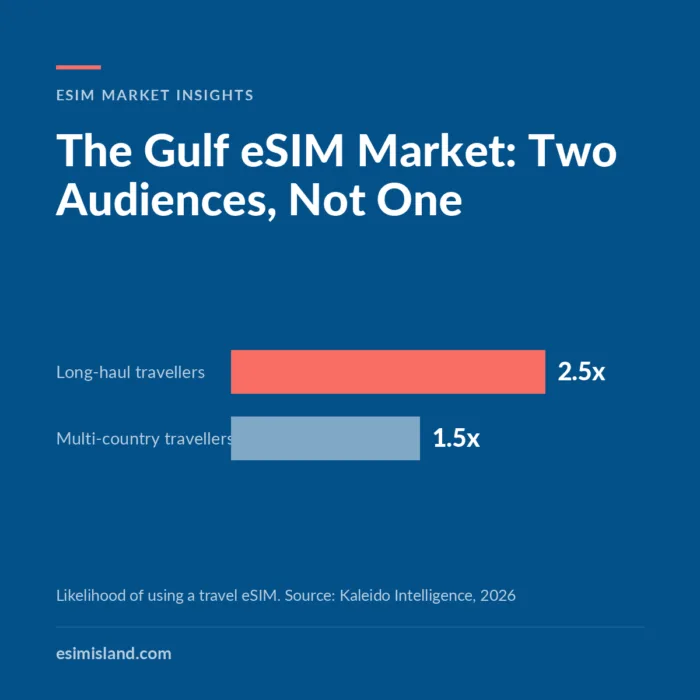
The travel profile is the core of it. Kaleido found long-haul travellers around 2.5 times more likely to use a travel eSIM and multi-country travellers around 1.5 times more likely. Gulf outbound travel is disproportionately both, which means the region over-indexes on exactly the behaviour that predicts conversion.
Global travel eSIM retail spend
Source: Kaleido Intelligence. Gulf markets are not sized separately in published research, so treat any GCC-specific figure you are shown with caution.
Two audiences, not one
The most common mistake in this region is treating it as a single premium market. It contains at least two distinct populations with different budgets, different travel patterns and different channels.
| Segment | Travel pattern | What they need | How to reach them |
|---|---|---|---|
| Nationals travelling for leisure | Long-haul, often multi-country, premium | Generous regional plans, reliability over price | Travel agencies, premium partnerships, Arabic content |
| Expatriate workers visiting home | Repeat trips to specific countries | Affordable single-country plans, frequent repeat | Community channels and language-specific content |
| Business travellers | Regional and long-haul, frequent | Managed connectivity, spend control | Sell to the employer, not the traveller |
| Religious travel | Seasonal, high volume, group-organised | Bulk provisioning, simple plans, group delivery | Tour operators and organisers rather than individuals |
| Transit passengers | Connecting through Gulf hubs | Regional plans covering onward destinations | Airline and airport partnerships |
| Inbound visitors | Business and leisure into the region | Local data on arrival | Depends entirely on your rates for Gulf networks |
Religious travel deserves separate mention because the buying structure differs entirely. It is seasonal, high volume and organised in groups, which makes the tour operator or organiser the customer rather than the individual traveller. Bulk provisioning against a group list is a far more efficient sale, and the product needs to be simple rather than feature-rich.
What works and what to check
What works
- Proper Arabic localisation, not machine translation
- Local payment methods and regionally familiar checkout
- Two product lines: premium leisure and affordable diaspora
- Group and bulk delivery for organised travel
- Partnerships with agencies and operators that hold the audience
What to check first
- Regulatory requirements in each specific market
- Whether identity verification is required at point of sale
- Any restrictions affecting voice or messaging apps over data
- Your wholesale rates for Gulf networks if selling inbound
- Which host carriers you use in the destinations your customers visit
The localisation point is worth taking seriously. Arabic is not a checkbox on a translation plugin. Poorly translated customer-facing copy actively signals that a provider is not serious about the market, and support responses in broken Arabic are worse than clear English. If you commit to serving the region in Arabic, budget for a native speaker reviewing everything a customer will read.
How to approach the market
Treat each country separately
The GCC is a convenient label and not a single market. Regulation, competitive intensity, operator pricing and traveller profile differ between states. A plan built for one is a starting hypothesis for the next, not a finished answer.
Pick which of the two audiences you serve
Premium leisure travellers and expatriate workers visiting home want genuinely different products at different prices through different channels. Attempting both with one offer usually serves neither well.
Verify the regulatory position per market
Requirements around identity verification and the sale of connectivity vary and matter more here than in most regions. This is a question for local advice rather than inference, and it is worth resolving before you build.
Localise properly or not at all
Arabic localisation done poorly reads worse than English done well. If you are going to serve this market in Arabic, budget for a native speaker reviewing customer-facing copy, including support responses.
Go through organisers for group travel
Seasonal and religious travel moves in organised groups. The buyer is the operator or organiser making one decision for many travellers, which is a far more efficient sale than reaching pilgrims or holidaymakers individually.
Check your rates before promising coverage
Whether you are selling outbound plans for Gulf travellers or inbound data for visitors, get per-country wholesale rates and named carriers for those specific markets. Regional strength in one direction says nothing about the other.
Step three is the one to resolve first rather than last. Requirements around identity verification and the sale of connectivity vary between Gulf states and are more consequential than in many regions. General guidance, including this article, is not a substitute for confirming your specific obligations in the specific markets you intend to sell into.
Frequently asked questions
Get pricing for Gulf corridors
eSIM Island supplies resellers serving the Gulf with wholesale rates, white-label stores, bulk provisioning for group travel and API access. Tell us your target markets and traveller segments and we will prepare a proposal.
Book a Free DemoOr explore the Reseller Program, API Integration and Business Roaming.
Leave a Reply