
Most content about business eSIM is written for organisations with hundreds of travellers and a mobility team. If you are six people who occasionally fly somewhere, almost none of it applies, and the honest answer to whether you should switch is sometimes no.
This is the small-business version: what the alternatives actually cost, a worked example you can substitute your own numbers into, what you genuinely need as opposed to what suppliers will demonstrate, and a clear view of the point at which it starts being worth the effort.
The honest answer for a small team
- If your team barely travels, the saving will not justify the effort. Stay where you are.
- The arithmetic starts working somewhere around a handful of international trips a year.
- Most of the value for small businesses is admin and predictability, not the price per gigabyte.
- You do not need enterprise features, and you should not pay for them.
- Check device eligibility first. It is the one thing that can stop this outright.
What you are choosing between
Small businesses usually handle international connectivity in one of four ways, often several at once without anyone deciding.
| Option | How it works | Good for | The catch |
|---|---|---|---|
| Operator roaming add-on | A daily or bundled roaming pass on your existing business plan | Very occasional travel; simplicity; one invoice | Usually the most expensive per unit of data, and daily passes add up fast |
| Staff buy their own travel eSIM | Employees purchase individually and expense it | Rare, unpredictable trips | No visibility, no control, and a reimbursement trail nobody enjoys |
| Local SIM on arrival | Buy a SIM in the destination country | Long stays in a single country | Lost time on arrival, a second number, and no data until it is sorted |
| Managed business eSIM | Plans assigned centrally, spend capped, usage visible | Regular travel by several people | Worth the setup only above a certain frequency |
The second row is the most common arrangement and the least visible. Staff buy a travel eSIM themselves, expense it, and nobody tracks the total. It works, in the sense that people have data, but it means you have no idea what connectivity costs you and no control over what gets bought.
The arithmetic
The category averages give you a starting point, though your own bills are what should decide it.
Average spend per trip, 2026
Source: Kaleido Intelligence traveller survey, 2026. Consumer averages. Your own roaming bill is the only number that matters for your decision.
Source: Kaleido Intelligence, 2026.
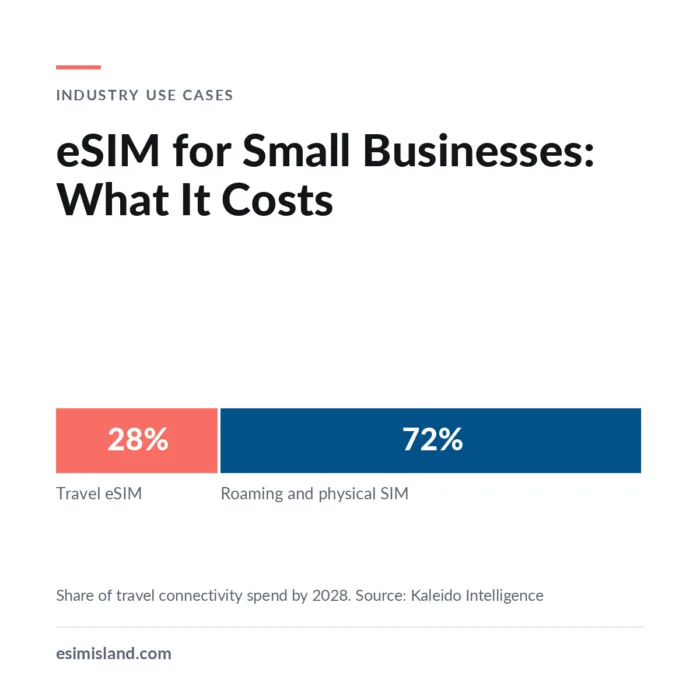
Kaleido Intelligence put average spend per trip at roughly $42 on operator roaming against about $28 on travel eSIM in 2026. That gap of around $14 is real but modest, and it is narrowing: roaming spend fell 9% year on year while travel eSIM spend rose 133% as buyers traded up to larger allowances.
| Line | Illustrative figure | Note |
|---|---|---|
| International trips per year, whole team | 24 | Six people averaging four trips each |
| Current roaming cost per trip | $42 | Replace with your own average from twelve months of bills |
| Annual roaming spend | $1,008 | 24 trips at $42 |
| Managed eSIM cost per trip | ($28) | Category average; negotiated business rates may differ |
| Annual eSIM spend | ($672) | 24 trips at $28 |
| Direct annual saving | $336 | Before any administrative time saved |
| Admin time recovered | Varies | Ordering, chasing, expensing and reconciling; often exceeds the direct saving |
Illustrative worked example using published category averages, not a quotation. Substitute your own trip count and per-trip cost; the shape of the result matters more than these figures.
Run that table with your own figures. If the direct annual saving comes out under a few hundred dollars and your admin overhead is genuinely low, the honest conclusion is that this is not yet worth your attention. That is a perfectly reasonable outcome and better discovered now than after a procurement exercise.
When it starts being worth it
| Your situation | Verdict | Reason |
|---|---|---|
| One or two trips a year, one person | Not yet | The saving is smaller than the time spent arranging it |
| Occasional trips, unpredictable destinations | Probably not yet | Per-trip purchases and expenses are simpler until frequency rises |
| Several people travelling a few times a year | Worth pricing | Direct saving plus meaningful admin reduction |
| Regular travel to the same destinations | Yes | Country-specific plans priced for repeat use are materially cheaper |
| Multi-country trips, any frequency | Yes | Regional plans avoid buying separately at every border |
| Staff based abroad rather than travelling | Different problem | Look at local arrangements, not travel products |
Two situations tip the balance faster than trip count alone. Repeat travel to the same destinations means country-specific plans priced for regular use, which are materially cheaper than ad hoc purchases. And multi-country trips mean regional plans, which avoid the alternative of buying something new at every border and are where the biggest practical difference shows up.
This matches the broader pattern in the data: long-haul travellers are around 2.5 times more likely to use a travel eSIM than short-haul ones, because the saving and the convenience both scale with distance and complexity.
What you need, and what to decline
What a small business actually needs
- Plans that can be assigned without shipping anything
- Clear pricing per destination with no minimum commitment
- A spend cap so one trip cannot produce a shock invoice
- One invoice instead of scattered expense claims
- Support that answers when someone is abroad
- Instructions staff can follow without help
What you can safely skip
- API integration; the dashboard is enough at this size
- Role-based access for regional administrators
- Cost centre reporting, unless finance already works that way
- Committed volume pricing before you know your usage
- Bulk provisioning tooling for a handful of people
- Formal SLAs you have no leverage to enforce
The one item on the left worth insisting on is the spend cap. It is the difference between a predictable line item and an invoice that arrives with a number nobody expected, and it is the single feature that most protects a small business from the downside of getting the plan sizing wrong.
How to decide, in an afternoon
Add up twelve months of actual spend
Roaming charges, daily passes, local SIMs bought on arrival and anything expensed for connectivity abroad. This usually takes an hour and is the only number that makes the decision for you. Most small businesses find it is higher than they assumed, because it is spread across several expense categories.
Count trips and destinations
How many international trips, by how many people, to where. Destination mix matters as much as volume, because rates vary enormously by country and a plan that suits one route can be poor value on another.
Check device eligibility
Confirm the phones in question support eSIM and are not carrier-locked. If they are not eligible, the decision is deferred to your next hardware refresh regardless of the arithmetic.
Get a quote against your real destinations
Generic pricing tells you nothing. Ask for rates in the countries you actually travel to, at your actual volume, with no minimum commitment. Compare it against the number from step one.
Trial on one trip before committing
Use it for a single real trip with one person. You are checking that installation is straightforward, coverage is good where you go, and support responds when it matters. One trip tells you most of what you need.
Review after six months
Compare actual spend against your baseline and check whether plan sizes match usage. Small businesses commonly over-buy allowances in the first months and can trim them once real consumption is visible.
Step one carries most of the weight. Connectivity spend in small businesses is usually scattered across roaming charges on the phone bill, expense claims for local SIMs, and individual travel eSIM purchases nobody consolidated. Pulling it together into one annual figure frequently produces a number the owner did not expect, and it makes the rest of the decision straightforward in either direction.
Frequently asked questions
Find out whether the numbers work for you
Send eSIM Island your destinations, rough trip count and current roaming spend and we will tell you plainly whether a managed arrangement is worth it at your size, with pricing for the countries you actually travel to.
Book a Free DemoOr explore the Reseller Program, API Integration and Business Roaming.
Leave a Reply