
Affiliate and creator partnerships fit travel eSIM better than most channels, for a reason specific to the category. The central obstacle here is not awareness or price, it is that customers are being asked to hand money to a company they have never heard of for something they cannot verify until they land in another country.
Paying for a recommendation addresses that directly in a way a paid click cannot. This covers which partner types are worth pursuing, what you can actually afford to pay, the terms worth setting up front, and the problems that appear once a programme has volume.
Why this channel suits the category
- You are buying a recommendation rather than attention, which addresses the trust gap directly.
- You pay on outcome, so it does not consume budget before it works.
- Travel creators already have exactly the audience, at exactly the right moment.
- The constraint is your margin: a $28 order sets a hard ceiling on commission.
- Coupon and content partners behave completely differently and should be treated differently.
What you are actually buying
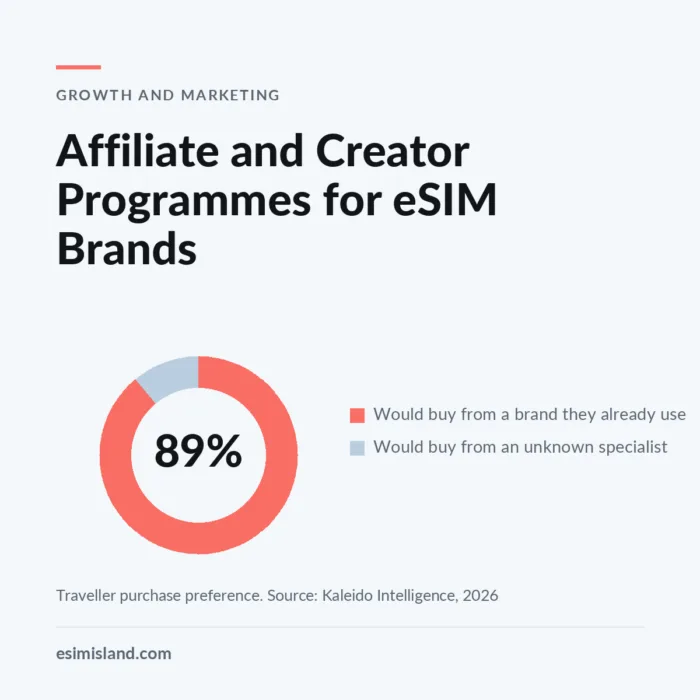
Where travellers say they would rather buy connectivity
Source: Kaleido Intelligence traveller survey, 2026. An affiliate or creator programme is a way of borrowing the trust on the upper bar.
Source: Kaleido Intelligence, 2026.
This is also why performance-based payment suits the category. You are not committing budget in advance to reach an audience that may not be travelling; you pay when a sale happens. For a business with limited capital and a low order value, that risk profile is considerably more comfortable than auction media.
Partner types, and which are worth the effort
| Partner type | What they bring | What to watch | Fit |
|---|---|---|---|
| Travel content creators | Genuine recommendation to a matched audience | Small volumes; needs relationship management | Strongest for this category |
| Destination bloggers | Search traffic with high purchase intent | Quality varies enormously | Very good, if the content ranks |
| Comparison and review sites | Volume, and buyers at the deciding moment | They also promote every competitor | Good, but you compete on commission |
| Coupon and deal sites | Volume at the checkout stage | Often claim credit for sales you already had | Treat with caution; restrict or exclude |
| Travel communities and forums | High trust within a specific corridor | Rules on promotion; needs authenticity | Excellent when done properly |
| Complementary businesses | Insurance, luggage, currency, tours | Slower to set up than a link | Underused and often the best value |
The complementary businesses row is the most underused. Travel insurance, currency, luggage, tour operators and airport transfer services all reach the same customer at the same moment, none of them compete with you, and a reciprocal arrangement costs neither party media spend. It takes longer to set up than adding a link to a network, which is precisely why few operators bother.
What you can afford to pay
Commission rates in this category are frequently set by copying whatever a competitor advertises, which has the same flaw as copying their retail price.
| Line | Illustrative | Note |
|---|---|---|
| Retail price | $24.00 | Around the category average order value |
| Gross margin after data and processing | $14.60 | Before any acquisition cost |
| Support and refund allowance | ($1.20) | Realistic for first-time buyers |
| Available for acquisition | $13.40 | The ceiling on commission before order one loses money |
| At 20% commission | $4.80 | Leaves clear contribution on the first order |
| At 40% commission | $9.60 | Aggressive, but viable if repeat rate is measured |
| At 60% commission | $14.40 | Above the ceiling; only defensible on proven repeat purchase |
Illustrative arithmetic using published category averages, not a quotation. Substitute your own rate card and measured costs.
The 60% row is included because it appears in the market. It is above the ceiling on a first order, which means it is only defensible if you have measured repeat purchase and know the second order arrives. Offering it without that evidence is a way of subsidising partners with capital you cannot replace.
A more useful approach than a single headline rate is tiering: a lower base rate for volume partners and coupon sites, a higher rate for content creators who genuinely introduce new customers, and the highest for partners in corridors where your wholesale rates are strongest and your margin is therefore larger.
Terms and the problems they prevent
Programme terms worth setting
- Commission on net revenue after refunds, not gross
- A cookie window matched to travel planning, not 24 hours
- Higher rates for content partners than coupon sites
- No bidding on your brand terms in paid search
- A clear position on discount codes and where they may appear
- Payment terms that hold until the refund window closes
Problems to expect
- Coupon sites intercepting customers already at checkout
- Partners bidding on your brand name
- Commission paid on orders that later refund
- Codes leaking to aggregators and eroding margin
- Last-click attribution over-crediting the final touch
- Partners promoting coverage claims you did not make
The cookie window deserves thought specific to travel. A 24-hour window undercredits partners badly, because travel purchases are researched weeks ahead of a trip and the eSIM is often bought much later. A window measured in weeks reflects how people actually plan and makes your programme materially more attractive to good partners.
Brand bidding is the term most often omitted and most often abused. A partner bidding on your own brand name intercepts customers who were already looking for you and charges commission for the privilege. Prohibit it explicitly and monitor for it.
Running the programme
Set your ceiling before you set your rate
Work out what is available for acquisition after data, processing, support and refunds. Your commission rate has to sit inside that number unless you have a measured repeat rate that justifies paying more for a first order.
Recruit for audience fit, not reach
A creator with a small audience of long-haul travellers on a corridor you serve will outperform a large general travel account. Long-haul travellers are around 2.5 times more likely to buy, and audience relevance beats follower count in a category this specific.
Give partners something real to say
Named carriers, honest coverage detail and specific destination guidance let a creator make a credible recommendation. Generic marketing copy produces generic content that nobody acts on.
Separate content partners from coupon sites
They do completely different work and should not earn the same rate. A creator introduces a customer who did not know you existed; a coupon site frequently intercepts one who was already checking out.
Protect the activation experience
Affiliate traffic converts into refunds at the same rate as any other if your device check and install instructions are weak. Commission paid on a refunded order is a straight loss, so fix the funnel before scaling the programme.
Review partners on net contribution
Rank partners by revenue after refunds and commission, not by gross sales. The ranking usually changes considerably, and it tells you where to invest relationship time rather than where the volume happens to be.
Step six changes decisions more than anything else on the list. Ranked by gross sales, coupon and comparison sites usually top the table. Ranked by revenue after refunds and commission, content partners and corridor communities frequently overtake them, because they introduce genuinely new customers who install successfully and come back. That second ranking is the one worth managing to.
Frequently asked questions
Better wholesale rates fund better partnerships
What you can pay a partner depends on your margin. Tell eSIM Island your target corridors and expected volumes and we will send per-country wholesale rates so you can build a commission structure that actually works.
Book a Free DemoOr explore the Reseller Program, API Integration and Business Roaming.
Leave a Reply