
Selling connectivity to companies is a different business from selling it to travellers, and most resellers who try it apply consumer instincts and stall. The orders are larger, the churn is far lower, and price matters much less. In exchange the sales cycle is longer and the buyer is not one person.
This is a practical outbound playbook: which organisations qualify, who to talk to and what each of them cares about, the discovery questions that surface the real problem, the objections you will meet, and why leading on cost is a mistake.
What makes corporate different
- Larger orders, far lower churn and much less price sensitivity than consumer.
- The buyer is not one person: IT owns devices, travel owns policy, finance owns budget.
- Nobody currently owns the problem, which is why it persists and why you can raise it.
- The saving is a weak pitch. Administrative burden and duty of care are stronger.
- Device eligibility qualifies or disqualifies an account before anything else.
Why now is a defensible reason to call
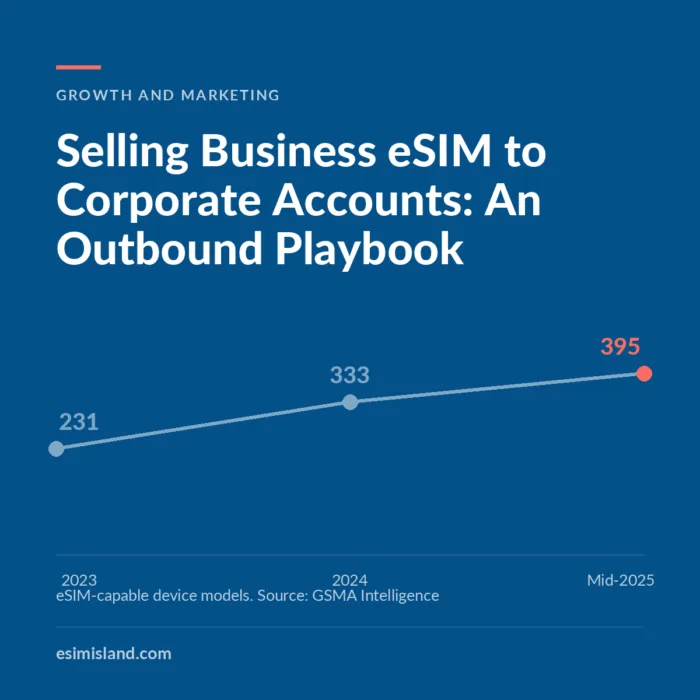
Cumulative eSIM-capable device models announced
Source: GSMA Intelligence device tracker. Corporate estates are becoming eSIM-eligible through ordinary hardware refresh, which is what makes the outbound timing work.
Sources: Kaleido Intelligence, 2026; GSMA Intelligence; GSMA Mobile Economy Report 2026.
This matters for outbound specifically because it gives you a legitimate reason to raise the subject rather than a manufactured one. You are not asking whether they would like to change suppliers. You are pointing out that their device estate is quietly becoming capable of something nobody has decided how to administer.
Who to target
| Signal | Why it qualifies | Where to find it |
|---|---|---|
| International travel is routine | The problem recurs rather than being occasional | Job postings mentioning travel, office locations, sector |
| 50 to 500 travelling staff | Large enough to need administration, small enough that operators ignore them | Headcount and structure |
| Multiple regions | Multi-country plans are where your product is genuinely better | Office footprint and client base |
| Recent hardware refresh | Estate is likely eSIM-eligible | Ask directly during discovery |
| A named travel or mobility function | Somebody exists to own the policy conversation | Job titles |
| Sectors with field or crew travel | Engineering, media, events, energy, logistics | Sector targeting |
The headcount row is the one that most improves hit rate. Small organisations produce orders too small to justify a sales cycle. Large enterprises attract direct operator competition and lengthy procurement. Organisations with roughly fifty to five hundred travelling staff need genuine administration and are rarely pursued aggressively by anyone, which is the gap worth working.
Who to talk to, and what to say
Four functions touch this, and they want different things. Pitching all of them the same way is the most common reason a promising conversation goes quiet.
| Who | What they care about | What lands | What does not |
|---|---|---|---|
| IT / mobility | Device estate, provisioning effort, support load | No shipping, remote assign and retire, fewer tickets | Cost per gigabyte |
| Travel manager | Traveller experience, policy, duty of care | Travellers reachable on arrival; policy that is enforceable | Technical provisioning detail |
| Finance | Predictability, allocation, expense processing | Caps before spend, usage by cost centre, fewer claims | Feature lists |
| Procurement | Terms, exit, comparability | Clear pricing, no lock-in, data ownership | Anything that sounds like a long commitment |
Deals stall when only one of these is engaged. IT alone cannot answer the policy questions; travel alone cannot answer the device ones.
The finance column is frequently the strongest entry point and the least used. Finance processes the expense claims for local SIMs and airport wifi one at a time, has no visibility of what connectivity actually costs in aggregate, and has no way to cap it. That is a problem stated in their own language, and they can usually convene the other stakeholders faster than you can.
Discovery and objections
Discovery questions that work
- How do staff currently get data when they land somewhere?
- What happens when someone arrives and cannot connect?
- Where does that spend show up, telecom or expenses?
- Who approves it when someone goes over?
- What proportion of handsets were bought in the last two years?
- Are any devices carrier-locked?
Objections you will hear
- "Our operator already gives us a roaming bundle"
- "Staff just expense a local SIM, it is fine"
- "Not all our phones support eSIM"
- "This is IT's decision, not mine"
- "We have no budget line for this"
- "We tried something like this and it did not stick"
The operator bundle objection is the most common and the most answerable. A bundle typically covers a set of destinations at a fixed daily or monthly rate, which works well for staff travelling to those places and poorly for anyone going elsewhere. Ask which destinations are covered and where staff actually travel; the gap between those two lists is usually the conversation.
The expense claim objection deserves a direct answer rather than agreement. It works in the sense that people stay connected, and it means the organisation has no idea what connectivity costs, no control over what gets bought, and a finance team processing claims manually. That is worth saying plainly.
Running the process
Lead with the administrative problem
Opening on cost invites a comparison with a roaming bundle they already have. Opening on what happens when someone lands without data, and where that spend currently hides, describes a problem they recognise and nobody owns.
Qualify on device eligibility early
Ask what proportion of handsets are recent and whether any are carrier-locked. An estate that is mostly ineligible is not a deal this quarter, and finding that out in the first call saves both sides months.
Get a second stakeholder into the conversation
A single contact cannot answer the questions the deal depends on. IT cannot set the allowance policy; travel cannot audit the devices. Ask early who else needs to be in the room and make it easy for them to join.
Help them find the real number
Almost no organisation has added the roaming line on the telecom invoice to the scattered expense claims for local SIMs and airport wifi. Offering to help assemble that figure is genuinely useful and usually produces the business case for you.
Propose a pilot, not a rollout
Twenty to fifty travellers across a full travel cycle is a decision a manager can make without procurement. It also produces the evidence that makes the larger deal straightforward rather than speculative.
Sell the quarterly review as part of the service
Committing to review spend, coverage and plan fit each quarter distinguishes a managed service from a supply arrangement, and gives you a scheduled reason to be in front of the account.
Step five is what converts interest into a deal. A full rollout requires procurement, a business case and multiple approvals. A pilot of twenty to fifty travellers is usually within a single manager’s authority, produces real data within one travel cycle, and turns the larger conversation from a projection into a measured result. It is also the point at which you find out whether the estate is genuinely eligible.
Frequently asked questions
Sell business connectivity with rates behind you
eSIM Island supplies business roaming with per-user caps, real-time usage and cost centre reporting through the Connect+ dashboard. Tell us about your target accounts and the markets they travel to and we will prepare wholesale pricing.
Book a Free DemoOr explore the Reseller Program, API Integration and Business Roaming.
Leave a Reply