
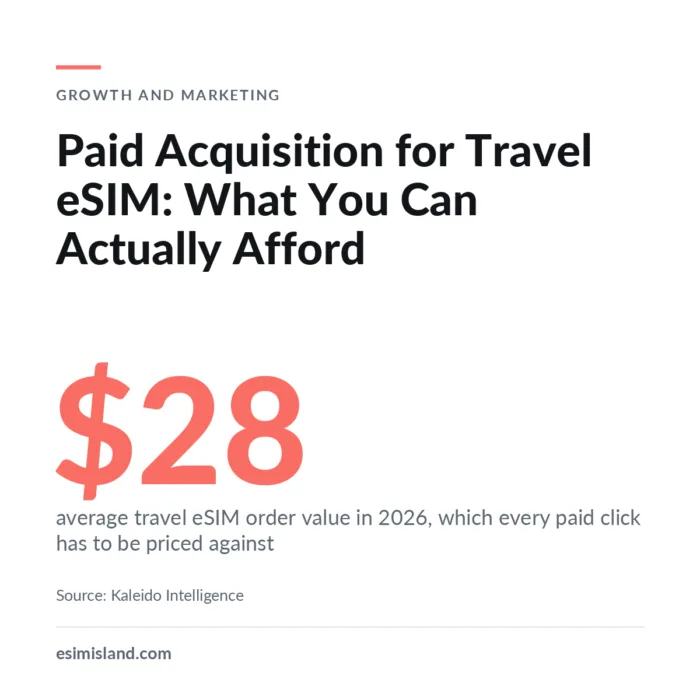
Paid acquisition is the default first move for a new travel eSIM business, and it is the channel most likely to quietly consume a launch budget. That is not because it does not work. It is because the arithmetic of a $28 average order value leaves very little room, and most operators run the campaign before running the calculation.
This is an honest assessment of where paid fits: what you can actually afford to pay, which formats and targeting have a chance, when it is defensible to lose money on a first order, and how to use it for what it is genuinely good at.
The honest position
- Paid search is excellent for learning and difficult as a primary volume channel.
- At a $28 order value, a first sale rarely survives auction pricing on generic terms.
- It works when a repeat rate carries it, or when targeting is narrow enough to cut cost per sale.
- Costs in this category rise as the market matures, not fall.
- Use it to answer questions quickly, then move budget to channels that compound.
What you can afford to pay
Start here, before choosing keywords or writing ads.
| Line | Illustrative | What it means |
|---|---|---|
| Retail price | $24.00 | Roughly in line with the category average order value |
| Gross margin after data and processing | $14.60 | Healthy, and the same for every competitor |
| Support and refund allowance | ($1.20) | Realistic for a first-time buyer |
| Available for acquisition | $13.40 | The absolute ceiling before a first sale loses money |
| At 2% conversion | $0.27 per click | What you can pay before breaking even on order one |
| At 4% conversion | $0.54 per click | Doubling conversion doubles what you can bid |
Illustrative arithmetic using published category averages, not a quotation or a performance claim. Substitute your own price, margin and conversion rate.
Source: Kaleido Intelligence, 2026.
The two conversion rows matter more than they look. Conversion rate is a multiplier on everything you can afford to bid, which means improving the landing page is functionally the same as being handed a larger budget. It is also permanent, whereas an auction win is rented.
Why costs rise rather than fall
Global travel eSIM retail spend
Source: Kaleido Intelligence. A category growing this fast attracts well-funded advertisers, which is why auction costs rise rather than fall.
A category forecast to approach $5 billion in 2026 and close to $10 billion by 2028 attracts advertisers with more capital, better data and longer payback horizons than a new entrant. Auction pricing reflects the most patient bidder, not the most efficient one. Anyone modelling a paid channel on today’s costs should assume they get worse.
Where paid has a chance
| Approach | Realistic outcome | Verdict |
|---|---|---|
| Generic head terms | Bidding against funded incumbents on broad intent | Avoid as a new entrant |
| Destination terms | Narrower intent, still contested | Test, but expect thin economics |
| Corridor and language-specific | Small volumes, low competition, high relevance | Often the only paid search that works |
| Brand defence | Cheap, protects traffic you already earned | Worth doing once you have a brand |
| Retargeting | Reaching people who already visited | Usually the best paid performance you will see |
| Social prospecting | Interrupting people not currently travelling | Poor fit; intent is absent |
| Creator and affiliate | Paying for a recommendation, not a click | Better fit than auction media for this category |
Retargeting is consistently the best-performing paid activity in this category, because it reaches someone who has already shown intent and already encountered your brand, which addresses the trust problem directly. It is also volume-limited by definition, which is why it is a supplement rather than a strategy.
Creator and affiliate arrangements deserve attention because they buy something different. You are not buying attention at auction, you are buying a recommendation from someone the audience already trusts. Given that trust is the category’s central obstacle, paying for it directly is often better value than paying for a click that has to overcome it.
When it works and when it does not
When paid can work
- You have a measured repeat rate that carries a thin first order
- You are targeting a narrow corridor or language
- Your average order value is above the category norm
- You are retargeting, not prospecting
- You are testing a message you will use elsewhere
- Your landing page converts well above 2%
When it will not
- Generic terms against funded competitors
- No measured repeat rate to justify a loss on order one
- Broad social prospecting to people not travelling
- A landing page that has never been tested
- No device compatibility check, so refunds erode the margin
- Treating it as the whole acquisition plan
The determining item on the left is a measured repeat rate. Paying more for a customer than a first order returns is a legitimate strategy when you know the second order arrives, and a slow way to lose money when you have assumed it. The distinction between those two positions is data you either have or do not.
How to use it well
Calculate your ceiling before you spend anything
Work out what you can pay for a customer before a first sale loses money, then divide by a realistic conversion rate to get your maximum cost per click. If the number is uncomfortably small, that is the finding, and it is better discovered on a spreadsheet than after three months of spend.
Decide whether repeat rate can carry a loss
Paying more than a first order returns is defensible only if you have measured repeat purchase and can show the second order arrives. Assuming a repeat rate you have not observed is how businesses fund competitors\' auctions with their own capital.
Start narrow, not broad
A single corridor, in one language, with matching landing pages. Narrow campaigns have lower competition, higher relevance and produce readable data quickly. Broad campaigns spend faster and teach you less.
Fix conversion before raising budget
Doubling landing page conversion doubles what you can afford to bid. That is usually cheaper and more durable than winning an auction, and the improvement carries over to every other channel you run.
Put compatibility checking in the funnel
Paid traffic that converts into refunds is worse than no traffic, because you paid for it twice. A device check before payment protects the economics of every campaign.
Use it to learn, then reallocate
Paid search answers questions faster than any other channel: which messages land, which destinations convert, what people actually search. Take those answers and invest them in content and distribution, which compound.
Step six is the most valuable and the least practised. Paid search will tell you within weeks which messages resonate, which destinations convert, and what language customers actually use, all of which are expensive to learn any other way. Treating it as a research budget rather than a growth channel is often the highest return available from the same spend.
Frequently asked questions
Better margins make every channel viable
What you can afford to pay for a customer depends on your wholesale rate. Tell eSIM Island your target destinations and expected volumes and we will send per-country pricing so you can model acquisition properly.
Book a Free DemoOr explore the Reseller Program, API Integration and Business Roaming.
Leave a Reply