
Consumption tax is the compliance topic eSIM resellers most often defer, partly because it is genuinely complicated and partly because nothing appears to go wrong for a while. It is also the one where deferring is most expensive, because obligations discovered retrospectively can carry back-tax and penalties on sales you have already spent the margin from.
This does not tell you what you owe, because that is jurisdiction-specific and changes. It sets out the questions that determine the answer, why the characterisation of the service matters, and what to put in place early so a practitioner can give you a quick answer rather than an expensive one.
The questions that determine everything else
- Is what you sell characterised as a telecommunications service or a general digital service?
- Are you the seller of record, or an intermediary acting for your provider?
- Where is the customer, and how would you evidence that?
- Does the jurisdiction have a registration threshold, and does it apply to foreign sellers?
- Is your headline price tax-inclusive or tax-exclusive?
Why this matters more at a low order value
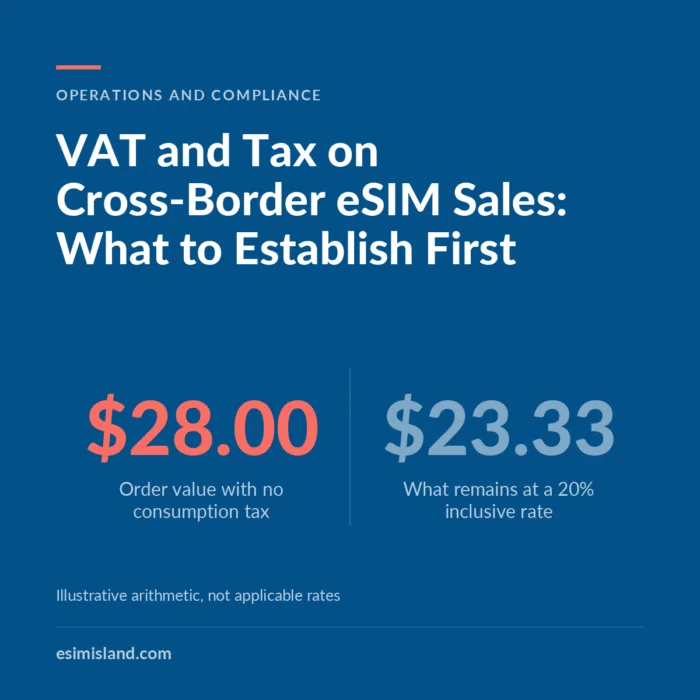
What a $28 order is worth to you at different consumption tax rates
Illustrative arithmetic on a $28 tax-inclusive price, not a statement of applicable rates. If tax is embedded in your headline price rather than added, it comes straight out of margin.
Source: Kaleido Intelligence, 2026.
The reason to take this seriously early is not the risk of an audit. It is that tax treatment affects your pricing decisions, and pricing set without accounting for it is difficult to unwind once customers have seen it.
The factors that decide the answer
| Factor | Why it matters | What to establish |
|---|---|---|
| Service characterisation | Telecommunications services often have their own place-of-supply rules, distinct from generic digital services | How your service is characterised in each market, with advice |
| Seller of record | Determines who accounts for the tax: you, or your provider | Whether your agreement makes you principal or agent |
| Customer location | Many regimes tax at the customer\'s location rather than yours | What evidence of location you capture and retain |
| Registration thresholds | Some apply only above a turnover level; some apply from the first sale for foreign sellers | The threshold, if any, in each market with volume |
| Marketplace rules | Some jurisdictions shift the obligation to a platform | Whether you sell through anything treated as a marketplace |
| Price presentation | Inclusive pricing absorbs tax into margin; exclusive adds it at checkout | Which you use, and whether it suits your markets |
The first two rows do most of the work. Both are questions for a qualified adviser rather than for a competitor\'s checkout page.
The characterisation question is the one most general guidance gets wrong, because most guidance about selling digital products cross-border is written about software, courses and media. Connectivity is not obviously the same thing, several regimes treat telecommunications distinctly, and a travel eSIM is consumed in a third country that is neither yours nor the customer’s home. Applying a general digital-goods answer to that is how people arrive at confident but incorrect positions.
Principal or agent
This is a contractual question with tax consequences, and it is answerable quickly.
| You are the seller of record | Your provider is | |
|---|---|---|
| Whose name is on the sale | Yours | Theirs, with you as intermediary |
| Who accounts for consumption tax | You, in the relevant jurisdictions | Generally them |
| Registration burden | Potentially in several markets | Substantially reduced for you |
| Pricing control | Full | Often constrained |
| Customer relationship | Yours | Depends on the agreement |
| Typical arrangement | White-label and API reseller models | Some affiliate and referral models |
This is a commercial and contractual question with tax consequences, not the other way round. Establish which model your agreement creates.
Most white-label and API reseller arrangements make you the seller of record: your brand is on the sale, you set the price, you take the payment. That generally means the consumption tax obligation is yours rather than your provider’s. Some referral and affiliate models work the other way. What matters is that your agreement says which, explicitly.
What to put in place
Get in place early
- Written confirmation of whether you are principal or agent
- Advice on how your service is characterised
- Location evidence captured and stored at checkout
- A clear position on inclusive versus exclusive pricing
- A list of markets where volume is material
- Invoices that meet local content requirements where needed
Problems that surface later
- Discovering a registration obligation retrospectively
- Tax-inclusive prices set without modelling the highest-rate markets
- No evidence of customer location for past sales
- Assuming the provider handles it because nobody said otherwise
- Platform or marketplace rules nobody checked
- Refunds processed without adjusting tax
Location evidence is the item worth acting on immediately regardless of your eventual position. If you later establish an obligation in a market, being able to show which sales were made to customers there is the difference between a manageable exercise and reconstructing history from incomplete records.
A sensible sequence
Settle principal or agent first
Everything downstream depends on it, and it is a contractual question you can answer this week. Ask your wholesale partner directly whether their agreement makes you the seller of record, and get the answer in the contract rather than in conversation.
Capture location evidence from day one
Whatever your eventual obligations, being unable to evidence where customers were is a problem that only worsens with time. Capture and retain the indicators available at checkout before you need them retrospectively.
Decide inclusive or exclusive deliberately
Tax-inclusive headline pricing is simpler for the customer and absorbs the tax into your margin, which varies by market. Exclusive pricing protects margin and adds friction at checkout. Model both against your highest-rate markets before choosing.
Identify your material markets
You do not need a considered position on two hundred countries. You need one on the handful where you have real volume, and a way of noticing when a new market becomes material.
Take advice before scale, not after
Registration obligations discovered retrospectively can carry back-tax and penalties. The cost of an hour with a practitioner who knows digital and telecom services is small relative to that, and the question is genuinely too jurisdiction-specific to resolve from articles.
Handle refunds and tax together
A refunded order usually needs its tax treatment reversed too. Build this into the process rather than discovering a reconciliation gap at year end.
Step five deserves stating plainly: this is a subject where reading more articles has diminishing returns quickly. The variables are jurisdiction-specific, the characterisation of connectivity is genuinely contested in places, and the cost of professional input is small against the cost of a retrospective assessment. Get the questions above answered, take them to someone qualified, and act on what they tell you.
Frequently asked questions
Know your position before you set prices
eSIM Island can confirm in writing whether our agreement makes you the seller of record, alongside per-country wholesale rates so you can model pricing including tax. Tell us your target markets and we will prepare a proposal.
Book a Free DemoOr explore the Reseller Program, API Integration and Business Roaming.
Leave a Reply