
“Business eSIM solutions” is a phrase suppliers use for at least three different products with different prices, different vendors and different reasons to buy. Working out which one you actually need is the fastest way to shorten a procurement process that otherwise involves a lot of demonstrations of features you will never use.
This guide is written for the company buying connectivity rather than reselling it. It covers what the term covers, what matters at your size, how to evaluate providers, how the pricing models differ and a procurement sequence that produces comparable quotes.
Before you shortlist anyone
- Decide which of the three products you are actually buying. They have different suppliers and different prices.
- Audit device eligibility. It is the constraint that most often derails a deployment.
- Know your current roaming spend and your top destinations, or no quote will be comparable.
- Agree caps, approvals and enabled destinations with finance before you evaluate platforms.
- Judge providers on lifecycle control and reporting, not on the headline rate.
Three products, one label
Before shortlisting anyone, establish which of these you are buying. Suppliers will happily discuss all three, and conversations sprawl accordingly.
| What you might mean | What it is | Who sells it | Buy it when |
|---|---|---|---|
| Business travel data | Data plans for staff travelling abroad, managed centrally | eSIM providers, business roaming specialists, some operators | Staff travel internationally and roaming costs or admin are a problem |
| Enterprise connectivity management | A platform to provision, control and report on connectivity across an estate | Managed service providers, enterprise mobility vendors | You have scale, multiple regions and a need for policy and cost allocation |
| IoT and device connectivity | Connectivity embedded in equipment, vehicles or sensors | IoT connectivity specialists | You are connecting things rather than people |
Suppliers frequently use the same term for all three. Establishing which one you need is the fastest way to shorten a procurement process.
Most organisations searching for business eSIM solutions want the first, sometimes growing into the second as they scale. The third is a genuinely separate market with different suppliers, and confusing it with the first is the most common reason a procurement process stalls in its early weeks.
Sources: GSMA Intelligence device tracker; GSMA Mobile Economy Report 2026.
What matters at your size
Requirements change sharply with headcount and geographic spread. Buying enterprise-grade administration for fifteen occasional travellers wastes money; buying a simple per-trip product for two hundred staff across many markets creates a manual reconciliation job.
| Your situation | What actually matters | What you can ignore for now |
|---|---|---|
| Under 20 travellers, occasional trips | Simple per-trip plans, clear pricing, no minimum commitment | Cost centre reporting, role-based access, API |
| 20-200 staff, several regions | Central provisioning, per-user caps, usage by team, alerts | Deep API integration unless you have systems to connect |
| 200+ staff, many markets | Bulk lifecycle control, role-based delegation, cost centre reporting, SLAs | Nothing; at this scale the administrative layer is the product |
| Field teams returning to fixed destinations | Country-specific plans priced for repeat use, generous validity | Broad global bundles you will not use |
| Executives crossing several borders per trip | Multi-country plans, reliable coverage, responsive support | Squeezing the last few percent off the rate |
The pattern is that below a certain scale you are buying data plans, and above it you are buying an administrative layer that happens to include data. The transition usually happens somewhere around fifty to a hundred regular travellers, or earlier if you operate across several regions with different requirements.
The cost case, and how to build it properly
Every supplier will show you a saving. The benchmark they use is rarely yours.
Average spend per trip, 2026
Source: Kaleido Intelligence traveller survey, 2026. Consumer benchmarks; negotiated business rates differ, which is why per-trip figures are a starting point rather than a quote.
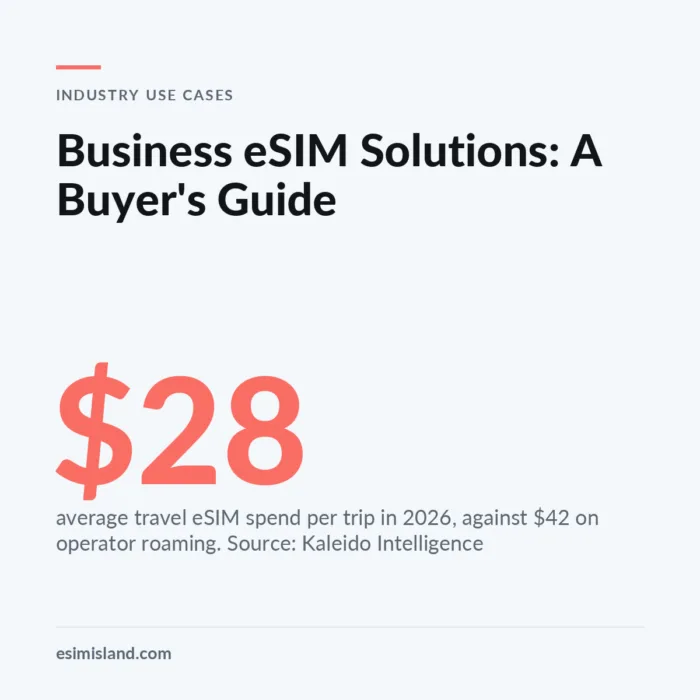
The 2026 category figures are around $42 average spend per trip on operator roaming against roughly $28 on travel eSIM, and roaming spend is falling while eSIM spend rises. Those are consumer averages, useful for orientation and not for a business case.
Two other costs belong in the calculation and are usually omitted. The administrative time currently spent ordering, shipping, chasing and reconciling SIM cards is real money, and for most organisations it exceeds the line-item saving. And the cost of an employee losing half a day of productive time on arrival because they have no data is worth quantifying at least roughly, because it is what the deployment actually prevents.
How to evaluate providers
Seven areas, of which price is one and rarely the deciding one.
| Evaluate | Ask for | Weak answer looks like |
|---|---|---|
| Coverage | Named host networks in your top destinations, contractual or not | "We cover 200+ countries" |
| Pricing | Rates by country at your volume; used versus allocated data; rounding | A single global rate, or a discount off retail |
| Control | Caps, alerts, approval flows, who can assign and retire profiles | Caps that are only visible after the billing period |
| Reporting | A real sample report grouped by team and cost centre | A screenshot of a dashboard with no export |
| Support | Hours, channels, escalation path, who answers your traveller | Email only, business hours, one time zone |
| Eligibility | Device compatibility data you can check your estate against | "Most modern phones support it" |
| Commitment | Minimums, term, notice period, what happens to profiles on exit | Long lock-in with a large deposit before a pilot |
The coverage answer is the most revealing. A country count costs nothing to claim. Named host networks per destination, with a statement of whether that is contractual, tells you what your travellers will actually experience and whether the supplier is close enough to the underlying agreements to fix problems in that market.
The reporting answer is the second most revealing. Ask for a real sample report rather than a description, and show it to whoever in finance will have to reconcile it. If they cannot map it to existing cost centres, the deployment will create work rather than remove it.
Pricing models and which fits
| Pricing model | How it works | Suits | Risk to you |
|---|---|---|---|
| Pay per plan | Buy a data package per trip or per user as needed | Occasional or unpredictable travel | Unbudgeted spikes in a heavy travel quarter |
| Pooled allowance | A shared data pool across the organisation | Mixed usage where some travel far more than others | A few heavy users consuming the pool |
| Per-user subscription | Fixed monthly fee per managed user, data included or separate | Predictable headcount and regular travel | Paying for quiet months |
| Committed volume | Lower rates in exchange for a volume commitment | Established, predictable usage | Committing before you know your real consumption |
Most organisations are better served by pay-per-plan or a pool in year one, then moving to a committed rate once actual usage is known.
A common and avoidable mistake is accepting a committed volume rate in year one to secure a better price. You do not yet know your real consumption, and a commitment set against a forecast usually turns out to be either wasted spend or an awkward renegotiation. Start flexible, measure for a year, then commit with data.
A procurement sequence that produces comparable quotes
Establish your baseline
Pull twelve months of roaming and local SIM spend, plus the destinations and rough trip counts behind it. Without this you cannot compare quotes or prove a saving afterwards. It usually takes an afternoon and it is the most useful thing you will do in the process.
Audit device eligibility
Check what proportion of the estate supports eSIM and whether any handsets are carrier-locked. This determines whether you are running a full deployment or a phased migration, and it changes the business case.
Agree policy with finance and HR
Allowances, overage approval, enabled destinations and who can administer profiles. Doing this before you evaluate platforms means you can test each one against real requirements rather than being shown features.
Brief three providers identically
Same destinations, same volumes, same requirements. Ask for rates by country, named carriers, a sample report and sandbox access. Identical briefs are the only way to make quotes comparable.
Pilot before you commit
Twenty to fifty users across a full travel cycle. You are testing activation success, support responsiveness, whether reporting fits finance\'s structure and whether plan design matches real usage.
Negotiate terms, then rate
Notice period, absence of a large upfront commitment, rate review timing and what happens to profiles if you leave are often more valuable than a small rate improvement, and suppliers usually have more room on them.
Step four is where most processes go wrong. Providers briefed differently will quote differently, and the resulting spreadsheet compares nothing. Same destinations, same volumes, same requirements, same request for named carriers and a sample report, and the comparison becomes straightforward.
Frequently asked questions
Get a quote against your actual travel data
Generic pricing tells you nothing. Send eSIM Island your destination mix, traveller headcount and current roaming spend and we will prepare a business roaming proposal with named coverage, per-country rates and a sample usage report.
Book a Free DemoOr explore the Reseller Program, API Integration and Business Roaming.
Leave a Reply